Introduction
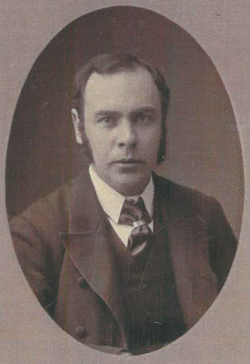
Robert William Perks (1849-1934) lived in Chislehurst, Kent, from shortly after his marriage in April 1878 until he, his wife Edith and their children moved to 11 Kensington Palace Gardens in 1894. Prior to April 1878, Perks had been living with his widowed mother in Highbury in North London; and Edith had been living with her parents in Banbury, Oxfordshire. If you take a map of South-Eastern England and draw on it a straight line from Tower Bridge in London to Folkestone on the Channel coast, you will find that approximately eleven miles from Tower Bridge your line passes slightly to the north of Chislehurst. The South-Eastern Railway (SER) opened a branch line into Chislehurst in July 1865. This “branch line” was extended south-eastwards to Tonbridge (and upgraded), and from May 1868 formed part of the SER’s “main line” connecting London to its cross-channel ferry service from Folkestone.[1] The existence of a frequent train service between Chislehurst and Cannon Street is likely to have been an important factor in the decision-making of R.W. Perks and his wife-to-be Edith Mewburn (1854-1943) regarding a suitable location for their first marital home.
It was in the latter months of 1875, shortly after Edith’s 21st birthday, that Perks and Edith had made public their engagement to be married.[2] In the April of that year Perks had completed his five years of “articles” and became qualified to practice as a solicitor. He had promptly been admitted into partnership with Henry Hartley Fowler (1830-1911) and Charles Corser (c.1816-1900). Corser and Fowler had a long-established legal practice in Wolverhampton. But the new partnership of “Corser, Fowler and Perks” was a separate entity, which was established at 147 Leadenhall Street in the City of London. Apparently it was at Perks’s insistence that such “spacious offices” on a major thoroughfare had been taken on,[3] and he no doubt felt there was a particular onus on him to make a success of what he later described as: “a bold experiment. A costly office, four clerks and no clients!”[4] These offices at 147 Leadenhall Street were Perks’s primary place of work from 1875 until 1887. Prior to his marriage, Perks was living in Highbury at the house his parents had bought there in 1867: 9 Leigh Road. From 1875, Perks’s typical business day routine probably involved walking from Leigh Road to Canonbury Station on the North London Railway (NLR), travelling on the NLR to its Broad Street terminal, and walking from there to 147 Leadenhall Street. In planning where to establish his first home with Edith, Perks was no doubt hoping that his journey-to-work routine would not be significantly more onerous than he had become accustomed to while at Highbury. Lubbock Road in Chislehurst fit that bill: about the same length of walk at the City end of the rail journey; a somewhat longer time on the train; but a somewhat shorter walk at the home end of the journey; — and a good level of frequency in the train service.
Chislehurst probably possessed two additional attractions to Perks and Edith. In terms of the continuum of alternatives from urban living to rural living Chislehurst probably held out the prospect of being not-dissimilar to what Edith had become used to while living in her parents’ house just outside Banbury in Oxfordshire. In 1881 the parish of Chislehurst had an area of 2,739 acres and a population of 5,341. And secondly, both Edith and Perks knew people who lived in Chislehurst. In February 1877 Edith Mewburn and R.W. Perks were reported as being members of “the bridal party” at the wedding of Sarah Elizabeth Vanner in the Marlborough Road Wesleyan Chapel in Banbury.[5] Sarah was a daughter of John Vanner (1822-1902) of “Springfields” just outside Banbury. Sarah’s family and the Mewburns were close friends. Edith had been a bridesmaid at the wedding of Sarah’s sister Helen in August 1871.[6] Also attending these weddings were John Vanner’s two brothers James Engelbert Vanner (1831-1906) and William Vanner (1834-1900) both of whom lived in Chislehurst. Both were prominent Wesleyan Methodist laymen — in regular contact with Perks’s father George Thomas Perks (1819-1877), President of the Wesleyan Methodist Conference in 1873-74, and its Secretary the preceding year. All three of the Vanner brothers were among the lay representatives at the Wesleyan Methodist Conference of 1878 (the first to admit lay representation), as were R.W. Perks and H.H. Fowler.[7] During the early 1870s, one of Perks’s closest friends in Highbury was Clarence Smith (1849-1941) — from 1895 Sir Clarence Smith. Son of Gervase Smith (1821-1882), Wesleyan Methodist Minister, Clarence lived at 13 Leigh Road. And together with Perks he was an active member of the Highbury Chapel Young Men’s Debating Society.[8] In June 1875, Clarence Smith married Mary Webster, daughter of William Thomas Webster (1814-1899) of Highbury Hill. The couple went to live in Chislehurst, where their first child was born in July 1876. Both Edith and Perks would probably have considered Chislehurst as a place where they would be welcomed into an active community of fellow Wesleyan Methodists, and provided with introductions to a broader circle of friends and associates of the people they already knew well, pre-Chislehurst.
The sixteen years from 1878 to 1894 saw a rapid take-off in Perks’s business career, and in the level of his income and personal wealth. He clearly worked very hard, on a sustained basis, on his various business and financial activities throughout those years. But the focus of this paper is not on Perks’s business activities during the 1878 to 1894 period.[9] Here, the focus is on “Perks in Chislehurst”. Section One attempts to set the scene by outlining the social profile of Lubbock Road, Chislehurst in the early years of the time Perks and Edith lived there. Section Two seeks to deepen that picture with information drawn from the 1891 Census and other relevant sources. An important source was Joanna Friel’s excellent history of Lubbock Road, Chislehurst, published in 2018, titled Fortune and Distinction.[10] Some of the facts and figures used in Sections One and Two are set out in the two Appendices to this paper. Joanna Friel’s 2018 book was also drawn upon substantially in preparing a number of the segments of Appendix A. Sections One and Two of this paper indicate that even before the move to 11 Kensington Palace Gardens in 1894, Perks and Edith were residing in an “up-market” environment. The level of R.W. Perks’s net wealth as at late 1877/early 1878 is not clear. It is possible that at the time he committed himself to establishing his first marital home in Lubbock Road, it was necessary for Perks to obtain some financial support from Edith’s very wealthy father, in order to render this do-able. This possibility is considered in the closing paragraphs of Section Two. Section Three looks at what is known about the activities of Perks and Edith in and around Chislehurst during the 1878-1894 period. Section Four tells the story of the continued ownership of the Lubbock Road property (“Claverley”) by the Perks family post-1894. From 1894 until the end of the First World War, Perks rented out Claverley to a sequence of tenants. But in 1920, or possible a little earlier, Perks’s son Robert Malcolm Mewburn Perks (1892-1979) moved into the house with his American-born wife Neysa and their two young daughters. This next-generation Perks family lived at Claverley until the second half of the 1930s, and both of Malcolm’s daughters attended Farringtons School in Chislehurst.[11]
Section Four is followed by some brief concluding comments. The paper has two appendices. The first comprises an alphabetic listing of the 28 individuals other than R.W. Perks who were recorded as being heads of household in Lubbock Road in either the 1881 Census, the 1891 Census or both — together with a summary of such information on each as seems relevant to the purposes of this paper. Two of the 28 were related to R.W. Perks: Samuel Hollis Perks and Alfred Constans Mitchell (the latter not as “directly” as the former). And there is an interesting connection between a third member of the 28, William Perry (1821-1897) and one of the earliest Companies Act companies which R.W. Perks was involved in the promotion of — “The Art Furnishers’ Alliance (Limited)”. Appendix B reproduces some descriptive material on various of the Lubbock Road houses that was published when those houses were advertised for sale or auction, or to let. This Appendix includes a description of Claverley that was published in April 1908. The material in this Appendix supports the point referred to above that a family needed to have ample means to fit into the Lubbock Road socio-economic environment of the 1878 to 1894 period.
I Lubbock Road, Chislehurst in 1881
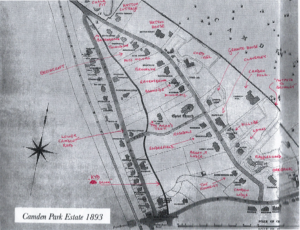
The 1881 Census gives us a snapshot of Lubbock Road on Sunday 3 April of that year, exactly three weeks before R.W. Perks’s 32nd birthday, which was also the date of his third wedding anniversary. The Census enumerator proceeded systematically. He commenced at the southernmost end of Lubbock Road and recorded details of the first residence on the right-hand, or north-eastern side (NES) of the road. He then proceeded north-westwards along Lubbock Road, recording details of each household on the NES of the road in sequence. When he reached the north-western-most end of the road, he crossed to the south-western side (SWS) and worked his way back along the road, recording details of each household on the SWS of the road in succession. By the time he reached his starting-point at the southernmost end of Lubbock Road he had recorded eighteen substantial family residences, eight along the NES of the road and 10 along the SWS. The Perks residence, “Claverley”[12] was the fifth (going northwards) on the NES. It was separated from the house which was its immediate neighbour to its south (“Hillside”) by a driveway which led north-eastwards up the hill to a further substantial “Lubbock Road” family residence located to the rear of Claverley. This was “Camden Hill” which the enumerator recorded last — after he had finished recording the houses along the SWS of Lubbock Road. In the summary in Table 1 below I have labelled “Camden Hill” as NES4A to indicate that the access-point for it was between house NES4 and house NES5. None of these houses had house-numbers at this time. The published directories of the 1880s and later usually record them in two lists, with both lists starting at the southernmost end of the road, one marked “Right Hand Side” (my NES) and the other “Left Hand Side” (my SWS):- with Camden Hill coming between Hillside and Claverley in the first of the two lists.
The most prominent building along Lubbock Road was Christ Church. Built during 1871 to 1872, this church had been originally designed to seat 500 and had a spire at its south-western end. During 1878 [check] the spire was taken down to allow the church to be extended to seat 700, and a 120-foot-high tower was constructed at the south-western corner of the building, containing a clock and one bell. Christ Church is approximately half-way along the SWS of Lubbock Road, and directly faced “Granite Lodge” on the NES, that being the house immediately to the north-west of Claverley. Of the ten residences recorded in the 1881 census on the SWS of Lubbock Road, eight were to the north and north-west of Christ Church and just two to the south of the church. Between the church and the first of these houses to its south (“Rosedale”, labelled SWS9 in the list below) a laneway ran south-westwards from Lubbock Road, down the hill and across a bridge over Kyd Brook and into Lower Camden road. The church was thus accessible from this direction, as well as from Lubbock Road. The principal entrance to the church was at the end furthest away from Lubbock Road.
The 1881 Census recorded one of the 19 substantial Lubbock Road houses as unoccupied (“Coed-bel”, NES7). Of the heads of household recorded at the remaining 18, R.W. Perks was the youngest at 31 years of age. The next youngest was Robert Taunton Raikes, 37, at “Enderfield” — which faced Claverley from the south-western side of Lubbock Road (SWS 10). The mean age of the seventeen heads of household excluding Perks was 55.9. At 26 Edith Perks was the youngest spouse of a head of household in Lubbock Road, but two others were quite close to her in age: Rosa Raikes, 27, at “Enderfield” and Ann Silver, 27, at “Hillside” (NES4). The next youngest was 40. Three of the heads of household in Lubbock Road were female (two widows aged 74 and 59 and one unmarried, aged 45). Of the male heads of household, two were widowers and the spouse of one of the others was not at home on census night. The mean age of the wives of the remaining twelve was 45.4.
Table 1: Lubbock Road Residences in 1881
| NES1: | “Oakbank” |
| Head of household (1881): Frederick Halsey Janson, aged 68. | |
| Occupants (1881): four family members of head; one visitor; eight domestic staff. | |
| NES2: | “Raggleswood” |
| Head of household (1881): Eliza Jane Janson, aged 74. | |
| Occupants (1881): three family members of head; six domestic staff. | |
| NES3: | “Lamas” |
| Head of household (1881): Francis John Johnston, aged 50. | |
| Occupants (1881): six family members of head; seven domestic staff. | |
| NES4: | “Hillside” |
| Head of household (1881): Hugh Adams Silver, aged 55. | |
| Occupants (1881): seven family members of head; seven domestic staff. | |
| NES4A: | “Camden Hill” |
| Head of household (1881): Henry Clutton, aged 62. | |
| Occupants (1881): nine family members of head; 10 domestic staff. | |
| NES5: | “Claverley” |
| Head of household (1881): Robert William Perks, aged 31. | |
| Occupants (1881): two family members of head; two domestic staff. | |
| NES6: | “Granite Lodge” |
| Head of household (1881): Frederick William Freese, aged 43. | |
| Occupants (1881): six family members of head; seven domestic staff. | |
| NES7: | “Coed-bel”a |
| Recorded as “Uninhabited” in 1881. | |
| NES8: | “Hatton House” |
| Head of household (1881): Betsey Lushington Edwards, aged 59. | |
| Occupants (1881): no family members of head; five domestic staff. | |
| SWS1: | “Beechbrook” |
| Head of household (1881): William Millman, aged 61. | |
| Occupants (1881): no family members of head, two domestic staff. | |
| SWS2: | “Thorndale” |
| Head of household (1881): William Perry, aged 60. | |
| Occupants (1881): one family members of head; four visitors; two domestic staff. | |
| SWS3: | “Beechcroft”b |
| Head of household (1881): George Shadbolt, aged 63. | |
| Occupants (1881): eight family members of head; five domestic staff. | |
| SWS4: | “Selwyns” (but this name not recorded until later) |
| Head of household (1881): Isabele (sic) Jane Monro, aged 45. | |
| Occupants (1881): three family members of head; five domestic staff. | |
| SWS5: | “Brooklyn” |
| Head of household (1881): Timothy O’Neil, aged 47. | |
| Occupants (1881): five family members of head; one visitor; three domestic staff. | |
| SWS6: | “Ravensbrook” |
| Head of household (1881): John Ross McDuff, aged 62. | |
| Occupants (1881): two family members of head; three domestic staff. | |
| SWS7: | “Bankside” (but this name not recorded until later). |
| Head of household (1881): Rev. William Fleming, aged 52. | |
| Occupants (1881): two family members of head; two domestic staff. | |
| SWS8: | “Cromlix” (later re-named “Kincraig”). |
| Head of household (1881): Christopher Oakley, aged 44. | |
| Occupants (1881): seven family members of head; four domestic staff. | |
| SWS9: | “Rosedale” |
| Head of household (1881): John Hugill, aged 68. | |
| Occupants (1881): seven family members of head; four domestic staff. | |
| SWS10: | “Enderfield” (formerly named “Braeside”). |
| Head of household (1881): Robert Taunton Raikes, aged 37. | |
| Occupants (1881): five family members of head; one visitor; four domestic staff. |
Notes:
a It seems likely that this property was in the possession of Katherine Amos by this time. She may have been operating her private school from other premises in Chislehurst at this stage while modifications to the Lubbock Road property were under way. She was recorded in the 1881 Census as living in Chislehurst and as “Schoolmistress”. Her household consisted of her sister Frances; one nephew, two nieces and a visitor, plus five schoolmistresses; 23 “scholars”, and seven domestic servants. The premises were described as “Coed-Bells” (sic), but the location does not appear to be on Lubbock Road. This Census entry is adjacent to the entry for the household of William Harvey, corn merchant, who (according to other sources) lived at 8 Florence Villas on Chislehurst Hill.
b Note that from 1894 this house served as the Christ Church Vicarage, and was known by that name.
The “typical” Lubbock Road household in 1881 thus had as its principal members persons significantly older than R.W. Perks and Edith then were. It also employed a larger complement of domestic staff. There were two domestic staff recorded at Claverley on census night. This was the same number as in three of the other Lubbock Road households, all of which were on the south-western side of the road (SWS1, SWS2, and SWS7). All the other households employed greater numbers of domestic staff. The mean for the full eighteen households stood at 4.8.
It seems likely that when R.W. Perks and Edith moved into Claverley in 1878, shortly after their marriage, they were the first occupants of the house — and that this was the most recently built of the 19 residences along Lubbock Road recorded in the 1881 Census. The 1876 edition of Strong’s Bromley Directory allows us to identify a total of 18 residences existing and occupied on Lubbock Road in that year. And 16 of those can be definitely “matched-up” with residences recorded in the 1881 Census through a matching house-name, matching occupants or both. The two from 1876 that remain after this cross-matching exercise are: “Braeside”, occupied in 1875 and 1876 by Mrs. Frederick Burgoyne Harrison; and “The Brook” occupied by W. Vaughan. The possibility that “Braeside” was the 1876 name of the house recorded as “Claverley” in the 1881 Census can be ruled out by the fact that advertisements for the sale of “Braeside” were published at dates sometime after R.W. Perks and Edith had moved into Claverley. Combining that fact with information from various wordings of entries in the 1882 Kelly’s Directory of Kent means we can be fairly confident that “Braeside” was the former name of the Lubbock Road house subsequently known as “Enderfield” (see the entry for SWS10 in Appendix B). One cannot be so confident about “The Brook”. But it seems reasonable to surmise that this was the earlier name of the house recorded as “Beechbrook” in the 1881 Census (SWS1) and that William Millman had superceded W. Vaughan as the occupant of that residence at some stage between 1876 and 1881. That leaves Claverley as the additional Lubbock Road residence that came into occupation between 1876 and 1881, and the Perks family as its first occupants.[13]
It is probably worth noting that Claverley was not the only Lubbock Road residence of relatively recent construction when R.W. Perks and Edith commenced living in Chislehurst. From the 1871 Census it appears that there were then eight houses along the road, seven of which can be identified as being Oakbank, Raggleswood, Lamas, Hillside, Camden Hill, Granite Lodge and Coed-bel — all situated on the NES of the road. The unidentified 1871 Lubbock Road house was occupied by Robert Norton (1838-1926), his wife Amelia (aged 28) and their two children Robert (2) and Gertrude (1). Robert Norton was a clerk in the War Office, but by 1881 had become a farmer and was living at Yalding in Kent. The Norton family’s residence was probably on the SWS of Lubbock Road. And all eight of these 1871 Lubbock Road houses had been constructed during the preceding ten years. The entire area upon which the 23 substantial Lubbock Road residences of 1891 stood had formed a portion of the Camden Park Estate when Nathaniel Strode (c.1817-1889) bought that Estate in 1860. During his first year of ownership Strode set about the process of subdividing this portion of the Estate into building plots, and arranging that purchasers of these plots should be bound by various covenants imposing restrictions regarding the future use of the land. Clearly Strode does not seem to have been in any great hurry in making sales of the various building plots. By ensuring that only quality residences with spacious gardens and grounds were built along the planned new road, he was no doubt able to hold-out for higher prices for the later plots sold than would have been the case if he had opted for minimal restrictions and maximum speed of sales at the outset. For more on Nathaniel Strode see Chapter One of Joanna Friel, Fortune and Distinction, 2018.
It is possible that the land Claverley was built upon in late 1877/early 1878 (or slightly earlier) was originally part of the building plot Strode had sold to Henry Clutton, upon which Clutton constructed Camden Hill (NES4A). Joanna Friel tells us that Strode was unhappy that Clutton had set about constructing his residence so high on the hill above Lubbock Road, where it was visible from the grand house of the Camden Park Estate, “Camden Place” (Joanna Friel, op. cit., p. 49). This appears to have led to litigation, during the course of which Strode pressed Clutton “to pull down his house and rebuild it at the foot of the hill” (loc. cit.). That alternative site may have been where Claverley was subsequently built. And that might explain the apparent peculiarity of the narrow laneway between Claverley and Hillside, giving access between Clutton’s Camden Hill house and Lubbock Road. If this were the case, Perks was probably able to obtain the site for Claverley at a price below that which Strode appears to have been asking for, in regard to his remaining building plots along the road during the later 1870s (see the final paragraph of Appendix B).
II Lubbock Road, Chislehurst in 1891
The 1891 Census gives us a second snapshot of Lubbock Road during the time that the principal residence of R.W. Perks was here. Census day in 1891 was Sunday 5 April, just under three weeks before Perks’s 42nd birthday and 13th wedding anniversary. Although neither Perks nor his wife or four daughters were recorded at “Claverley” on Lubbock Road in this census, the family being away at their holiday-home of the same name on the sea-front at Littlestone on the Channel coast, this 1891 snapshot of Lubbock Road adds to our picture of the home environment of Perks during his Chislehurst years. This snapshot dates from three years before the Perks family’s principal residence was relocated to 11 Kensington Palace Gardens. The 1881 snapshot dates from three years after Perks and Edith settled in Chislehurst. Taking the two in combination ought to give some reasonable insights into the nature of that environment over the 16 years as a whole.
The Census enumerator of 1891, like his predecessor of 10 years earlier, commenced his task at the southernmost end of Lubbock Road. But unlike his predecessor he did not traverse the length of one side of the road, and then take details of the properties on the opposite side of the road while working his way back to his starting-point. Instead, he proceeded north-westwards along the road criss-crossing from one side to the other, completing his record of Lubbock Road in one sweep, prior to exiting from the north-western-most end of the road. By 1891, a further four substantial family residences had been constructed, in addition to the 19 existing in 1881. One of these new four was at the north-westernmost end of the north-eastern side of the road: “Hatton Cottage”, labelled NES9 in Table 2 below. The other three were on the south-western side of the road, to the south of the southernmost 1881 house on that side of the road. These three are labelled SWS11, SWS12, and SWS13 in Table 2. This took the complement of Lubbock Road houses to the “23 grand Victorian piles” referred to by Joanna Friel in the introduction to her 2018 history of Lubbock Road Fortune and Distinction (op.cit.).
Of the 23 heads of household in this 1891 snapshot of Lubbock Road 12, including R.W. Perks were “survivors” from the 1881 snapshot, but two of these had moved to different houses. Hugh Adams Silver had moved from “Hillside” on the north-eastern side of the road (NES4) to a larger newly-built house on the south-western side “Abbey Lodge” (SWS17). And the Rev. William Fleming had moved from “Bankside” on the south-western side (SWS7) into “Hillside”. It should probably be noted that in the 1881 Census, the enumerator had recorded the name of SW7 as “Camden Parsonage”. But the trustees responsible for the building of Christ Church had not succeeded in raising sufficient funds to establish a permanent parsonage for the incumbent of the new church. Instead a lease was taken out on a conveniently situated house, and the Rev. Fleming needed to undertake a series of relocations during his incumbency at Christ Church.[14]
Table 2: Lubbock Road Residences in 1891
| NES1: | “Oakbank” |
| Head of household (1891): Thomas Jackson, aged 49. | |
| Occupation of head of household: Bank Manager, “employed” (i.e. in employee status). | |
| Occupants (1891): five family members of head; nine domestic staff. | |
| Rooms-count from 1911: 21. | |
| NES2: | “Raggleswood” |
| Head of household (1891): John Innes Rogers, aged 50. | |
| Occupation of head of household: Wholesale Grocer, “employer”. | |
| Occupants (1891): six family members of head; six domestic staff. | |
| Rooms-count from 1911: 18. | |
| NES3: | “Lamas” |
| Head of household (1891): Francis John Johnston, aged 60. | |
| Occupation of head of household: Retired Brazilian Merchant. | |
| Occupants (1891): three family members of head; seven domestic staff. | |
| Rooms-count from 1911:a 18. | |
| NES4: | “Hillside” |
| Head of household (1891): Rev. William Fleming, aged 62. | |
| Occupation of head of household: Vicar of Christ Church. | |
| Occupants (1891): two family members of head; three domestic staff. | |
| Rooms-count from 1911: not available. | |
| NES4A: | “Camden Hill” |
| Head of household (1891): Edward Graeme Gibson, aged 51. | |
| Occupation of head of household: Solicitor. | |
| Occupants (1891): five family members of head; eight domestic staff. | |
| Rooms-count from 1911: 24. | |
| NES5: | “Claverley” |
| Head of household (1891): not present (Robert William Perks, aged 41). | |
| Occupation of head of household: Solicitor (his occupation as reported in the Littlestone section of the Census). | |
| Occupants (1891): zero family members of head; five domestic staff. | |
| Rooms-count from 1911: 17. (Note that Perks had spent over £1,000 on extending the house in 1886.) | |
| NES6: | “Granite Lodge” |
| Head of household (1891): Frederick William Freese, aged 53. | |
| Occupation of head of household: Exchange and Banking Agent, “employer”. | |
| Occupants (1891): three family members of head; three domestic staff. | |
| Rooms-count from 1911: 12. | |
| NES7: | “Coed-bel” |
| Head of household (1891): Katherine Elizabeth Amos, aged 58. | |
| Occupation of head of household: School Mistress, “employer”. | |
| Occupants (1891): two family members of head (both employed as teachers); six teachers who are not family members of the head; 13 domestic staff; 34 pupils (aged 13 to 18 all female). | |
| Rooms-count from 1911: 31 rooms plus 32 “cubicle rooms”. | |
| NES8: | “Hatton House” |
| Head of household (1891): Hannah Mawe, aged 61. | |
| Occupation of head of household: “Living on own means”. | |
| Occupants (1891): nine family members of head; five domestic staff. | |
| Rooms-count from 1911: 16. | |
| NES9: | “Hatton Cottage” |
| Head of household (1891): Warwick Webb, aged 35. | |
| Occupation of head of household: Solicitor, “employer”. | |
| Occupants (1891): three family members of head; two domestic staff. | |
| Rooms–count from 1911: 12. | |
| SWS1: | “Beechbrook” |
| Head of household (1891): William Millman, aged 72. | |
| Occupation of head of household: Solicitor, “employer”. | |
| Occupants (1891): zero family members of head; two domestic staff. | |
| Rooms-count from 1911: 12 | |
| SWS2: | “Thorndale” |
| Head of household (1891): William Perry, aged 70. | |
| Occupation of head of household: Australian Merchant, “employer”. | |
| Occupants (1891): two family members of head; one visitor; three domestic staff. | |
| Rooms-count from 1911: 12. | |
| SWS3: | “Beechcroft” |
| Head of household (1891): George Shadbolt, aged 73. | |
| Occupation of head of household: Wood Broker (but neither employer nor employed). | |
| Occupants (1891): two family members of head; three domestic staff. | |
| Rooms-count from 1911: 11. | |
| SWS4: | “Selwyns” |
| Not recorded in the 1891 Census.b | |
| Rooms-count from 1911: 13. | |
| SWS5: | “Brooklyn” |
| Head of household (1891): Samuel Hollis Perks, aged 61. | |
| Occupation of head of household: Retired Edge Tool Maker. | |
| Occupants (1891): two family members of headc; three domestic staff. | |
| Rooms-count from 1911: 10. | |
| SWS6: | “Ravensbrook” |
| Head of household (1891): John Ross MacDuff, aged 72. | |
| Occupation of head of household: Author and Retired Clergyman of the Church of Scotland. | |
| Occupants (1891): one family members of head; two domestic staff. | |
| Rooms-count from 1911: 13. | |
| SWS7: | “Bankside” |
| Head of household (1891): John Foster Pickering, aged 52. | |
| Occupation of head of household: Retired Architect. | |
| Occupants (1891): two family members of head; one domestic staff. | |
| Rooms-count from 1911: 8. | |
| SWS8: | “Kincraig” (formerly named “Cromlix”) |
| Head of household (1891): James Alexander Cruickshank, aged 43. | |
| Occupation of head of household: Hay Factor, “employer”. | |
| Occupants (1891): four family members of head; four domestic staff. | |
| Rooms-count from 1911: 16. | |
| SWS9: | “Rosedale” |
| Head of household (1891): John Hugill, aged 78. | |
| Occupation of head of household: Druggist and Lozenge Manufacturer, “employer”. | |
| Occupants (1891): four family members of head; three domestic staff. | |
| Rooms-count from 1911: not available. | |
| SWS10: | “Enderfield” (formerly named “Braeside”) |
| Head of household (1891): Robert Taunton Raikes, aged 47. | |
| Occupation of head of household: Solicitor, “employer”. | |
| Occupants (1891): eight family members of head; four domestic staff. | |
| Rooms-count from 1911: 14. | |
| SWS11: | “Abbey Lodge” |
| Head of household (1891): Hugh Adams Silver, aged 65. | |
| Occupation of head of household: Colonel H.M. Volunteer Forces (and neither employer nor employed). | |
| Occupants (1891): eight family members of head; one visitor; five domestic staff. | |
| Rooms-count from 1911: 23. | |
| SWS12: | “The Rookery” (but this name not recorded until later). |
| Head of household (1891): Alfred Constans Mitchell, aged 50. | |
| Occupation of head of household: Steel Pen Merchant (but neither employer nor employed). | |
| Occupants (1891): no family members of head; three domestic staff. | |
| Rooms-count from 1911: 15. | |
| SWS13: | “Camden Lodge” |
| Head of household (1891): not present (Peter Frederick Wood, aged 43). | |
| Occupation of head of household: “Living on means” (and neither employer nor employed). | |
| Occupants (1891): five family members of head; five domestic staff. | |
| Rooms-count from 1911: 15. |
Notes:
a Note that in 1911 this house was being used as a school (St. Hugh’s).
b But “Miss Monro” is recorded as the occupier in the 1889 Strong’s Directory of Bromley. And when “Selwyns” was advertised to be auctioned at the Mart on 23 May 1892, it was described as “Occupied by the resident owner for nearly 20 years past” (Bromley & District Times, 8 April 1892, p. 4). This suggests that although absent on Census night, the head of household in 1891 continued to be Isabele Jane Monro — by this stage aged 55. In the 1901 census she was again recorded at this house, aged 65, “living on her own means”. Isabele Jane was the only daughter of the barrister John Boscawen Monro who died in 1847. She lived with her mother until the death of the latter (at 4 Gloucester Terrace, London) in February 1874. She then appears to have bought this property in Lubbock Road jointly with her aunt, Elizabeth Jane Munro (born 17 November 1785). When Elizabeth Jane died at the Lubbock Road house in August 1876, Isabel Jane became the sole owner.
c Samuel Hollis Perks (1830-1910) was a cousin of R.W. Perks and a member of the syndicate organised by the latter to take-up the June 1887 issue of preference shares in the Barry Dock and Railway Company. Sam’s two family members recorded with him at Brooklyn on census night were his wife and the older of his two sons, Edwin. Edwin’s occupation is recorded as “Articled Clerk in Solicitor’s Office”. He had commenced his “articles” in R.W. Perks’s office in March 1887.
In 1891, R.W. Perks was no longer the youngest head of household on Lubbock Road. That honour was now held by Warwick Webb (aged 35) at “Hatton Cottage (NES9). Now aged 41, Perks was the second youngest. Two others were not much more than a year older than Perks: James Alexander Cruickshank at “Kincraig” (SWS8); and Peter Frederick Wood at “Camden Lodge” (SWS13). But the mean age of all of the 22 heads of household excluding Perks was 57.1. Edith Perks was no longer the youngest spouse of a head of household. Eliza Webb of “Hatton Cottage (NES9), at 31, was the youngest, with Edith (now 36) the second youngest. There were three other wives of heads of household in Lubbock Road in 1891 aged below 40: Rosa Raikes at “Enderfield” (SWS10); Ann Silver at “Hillside” (NES4); and Emily Wood at “Camden Lodge” (SWS13). In 1891 three of the Lubbock Road households had female heads (one widow aged 61 and two unmarried, aged 55 and 58). Of the male heads of household, three were widowers and one was single. The mean age of the wives of the total of the remaining sixteen was 48.1.
This second snapshot of Lubbock Road during the Perks household’s time there thus continues to indicate that theirs was a household whose principal members were significantly younger than was the “average” along the road. But this second snapshot tells us that the story regarding the size of the complement of domestic staff employed by R.W. Perks and Edith compared with the Lubbock Road average had changed since 1881. In 1881 they had been recorded as employing two domestic staff, compared with a mean of 4.8 for all of the households along the road. In 1891 there were five domestic staff at “Claverley” in Lubbock Road on census night. And at their holiday home in Littlestone, R.W. Perks and Edith had with them a domestic staff of four, at least two of whom would seem to have normally lived at their Lubbock Road residence. Of the 23 residences along Lubbock Road, “Coed-bel” (NES7) was a special case, being a private school with 34 boarding pupils, and “Selwyns” (SWS4) was empty on census night 1891. The mean domestic staff complement for the remaining 21 residences was 4.2. (This includes counting Claverley as 7.) The median for the 21 was three. The Perks household in 1891 was clearly employing a markedly larger complement of domestic staff than the “average” for their peers along Lubbock Road, whereas in 1881 the converse had been the case.
The up-sized complement of domestic staff employed by R.W. Perks and Edith included Minnie Ada Strickland, described as “nurse” in the 1891 census. An obituary of Minnie was published in The Bromley Mercury of 27 April 1928 (at p. 3). It stated: “She had lived in Chislehurst since girlhood. For many years she was nurse to the children of Sir Robert and Lady Perks when they lived at Claverley, Lubbock-road … she did a considerable amount of work for Chislehurst Wesleyan Church, particularly in connection with the Sunday school and the Wesley Guild.” This suggests that although Minnie Strickland was recorded in the 1891 census at the Perks’s holiday home in Littlestone, it was their Lubbock-road house that was her “base”. Her time at Lubbock Road came to a close in mid-1892 when she married Harry Wise, son of the Chislehurst High Street butcher, James Wise. The couple had five children, three of whom had died prior to Minnie’s death in April 1928.
By 1891, R.W. Perks and Edith were employing a coachman, Henry Benjamin Gayler (1855-1933). It seems likely that Perks had taken-on Henry Gayler quite early in the 1880s, and the connection between the Perks family and the Gayler family proved to be of long duration. In the 1901 Census Gayler was still employed as Perks’s coachman, and was then at Kensington Palace Gardens, where the younger of his two sons (Ernest) was a “footman” on the Perks family’s domestic staff. In the 1911 census H.B. Gayler was recorded as coachman at Perks’s country residence, Wykham Park, near Banbury; Ernest as a footman at 11 Kensington Palace Gardens; and Herbert Henry Gayler (1881-1917), Ernest’s older brother, was working as a solicitor’s clerk for Perks’s brother George Dodds Perks. In the 1921 Census we find Ernest Gayler back at Claverley, Lubbock Road, Chislehurst — employed by R.W. Perks’s son Malcolm as “Manservant … Butler”. During the 1920s and 30s his services to the Perks household expanded to include those of “chauffeur” (see Section IV below). Herbert Henry Gayler died in India, on military service, in 1917. In 1912 he had been a member of the cycling team that represented Britain at the Stockholm Olympics.[15]
A third member of the upsized complement of domestic staff employed by R.W. Perks and Edith in 1891 was Emily Birchenall French (1865-1940). Her occupation was described in the 1891 Census as “Lady Help”, with that same phrase recorded as her “Relation to Head of Family”. Her father was Alfred John French (1835-1921), a Wesleyan Methodist Minister and tutor in Mathematics and Philosophy at Didsbury College in Manchester. Her uncle was Henry French (1831-1919) who combined the teaching of mathematics with being accountant and bursar at the Queens College, Taunton. He had been elected one of the five lay representatives for the Exeter District to the 1878 Wesleyan Methodist Conference. When the Queens College, Taunton was registered as a limited liability company in October 1888, with Perks as one of its initial subscribers and one of its eight initial directors, Henry French was the secretary of the company.[16]
At the time of the April 1881 Census R.W. Perks and Edith had only one child, Gertrude, born at Claverley on 7 September 1879. As at April 1891, there were three more daughters: Mildred born 13 March 1882; Edith Mary born 22 February 1884; and Margaret Hilda born 18 December 1885. The larger-sized family would clearly have brought with it a requirement for more work about the house. And the house itself underwent an increase in its dimensions between 1881 and 1891. At some stage prior to February 1886, Perks had commissioned the architect Charles Bell (1846-1899) to design extensions to Claverley including a conservatory and a library. Perks had called for tenders to do the work, and he accepted that of £1,077 submitted by Mr Lowe of Chislehurst.[17] On 26 January 1887 Perks’s cousin John Hartley Perks travelled to Chislehurst to visit both his half-brother Samuel Hollis Perks and R.W. Perks. His diary entry for the day includes: “I had tea at Robert’s. The new library is a fine room and the enlargement has much improved the house”.[18] But the principal factor behind the expansion in the size of the complement of domestic staff employed at Claverley, between 1881 and 1891, was probably not so much the expansion in the size of Perks’s family or in the size of his Lubbock Road house, as the expansion in the size of Perks’s income during this decade.
It seems clear that none of the residences along Lubbock Road at the time R.W. Perks and Edith lived there could reasonably be described as small. But at the time of the 1881 Census, Claverley may well have been the smallest in size of the houses along the north-eastern side (NES) of the road. The 1911 British Census was the first that recorded a count of the rooms in each house. The figures for the Lubbock Road residences from that source are reported in Table 2. Two of the houses were unoccupied at the time of the 1911 Census (NES4 and SWS9) and room-counts for those two are thus unavailable. If we treat Coed-bel (NES7) as a special case and focus on the remaining 20 Lubbock Road residences, these 1911 figures indicate that in that year five of the houses had a greater number of rooms than Claverley (four of them being on the NES of the road) while 14 had a smaller number of rooms. Some further information on the relative sizes of the Lubbock Road houses is available from advertisements that were published from time to time offering one or other of the properties for sale or to let. These advertisements also typically indicated the size of the gardens and grounds that were attached to the house being described. A summary of the information from the advertisements I have so far discovered is presented in Appendix B. One gets the impression that the median Lubbock Road house stood in grounds of around two acres, and that Claverley was perhaps a little below that median. Camden Hill House (NES4A) sat in substantially more extensive grounds, as did Oakbank (NES1) Raggleswood (NES2), and Hatton House (NES8).
Of the 28 individuals who were heads of household of Lubbock Road residences in either 1881, 1891, or both, only one outlived R.W. Perks. That was Walter Webb (at NES9 in 1891) who lived until January 1946. Probate calendar entries have been found for all but three of these individuals, and the wealth at death information from those entries is set out in Appendix A. Except for those four of the 28 who died prior to 1894, these wealth at death figures are not to be relied upon as indicators of the wealth levels of these persons during the time they were neighbours of R.W. Perks on Lubbock Road. And other things being equal, the later it was after 1894 that the individual died, the lower the level of probability that these probate figures give a useful indication of the pre-1894 wealth status of that individual. With those caveats in mind, it might nevertheless be of some value to note that the median wealth at death of the 28 Lubbock Road neighbours of Perks covered by Appendix A was in the zone £20,485 to £20,792. The 25 per cent with the highest levels of wealth at death, left estates of at least £78,000. The 25 per cent with the lowest levels of wealth at death left estates valued at up to about £4,000. These figures are based on treating all three individuals for whom no probate calendar entries have been discovered as having had zero or negligible wealth at death. Appendix A contains additional information on each of those three individuals. Two of them appear to have got into severe financial difficulties which did not manifest themselves until the early 1890s. Prior to that, both Hugh Silver (1825-1912) and William Perry (1821-1897) would have been perceived as successful business figures of substantial personal wealth.
The occupational mix of the Lubbock Road heads of household of 1881 and 1891 is quite interesting. Only one seems to have had as their principal source of income work in the status of employee. That was Thomas Jackson (from 1902 Sir Thomas Jackson) whose career with the Hong Kong and Shanghai Bank is outlined by Joanna Friel in chapter four of her 2018 history of Lubbock Road Fortune and Distinction. The others in remunerative employment were either in professional practice (five solicitors, one architect and one Church of England clergyman), or owner-managers of commercial enterprises. Eleven (about 40 per cent) were not in remunerative employment and were supporting themselves from their wealth — in some cases accumulated prior to their retirement from remunerative employment; in other cases inherited. The available information on the occupational status of the Lubbock Road heads of household who were neighbours of Perks during his Chislehurst years is summarised in Appendix A. Only two of the 28 Lubbock Road heads of household were born in Kent (Walter Webb and Christopher Oakley).
It would be interesting to have some data on what it cost Perks to buy the plot of land for his Lubbock Road house, and what his costs of constructing Claverley on that site were. I have not been able to discover any such information. Joanna Friel tells us that the plot of land on which “Granite Lodge” was constructed (the house immediately to the north-west of Claverley) had cost the Freese family £1,195 at the end of the 1860s (see Appendix B). The fact that Perks’s 1886 extensions to Claverley cost him over £1,000 makes one inclined to suspect that the pre-1886 structure had probably cost more than £1,000 to construct. If we assume that land values along Lubbock Road did not deteriorate markedly during the first half of the 1870s we seem to be looking at an estimate of £2,000, at the minimum, as the costs of Perks and Edith establishing Claverley as their first marital home. Bearing in mind that Perks’s income from legal work was zero prior to April 1875, this tends to make one curious as to where that £2,000/plus of late-1877/early-1878 outlays came from.
The 1909 Crane biography of Perks tells us that he generated some income for himself through journalism, during the time he was serving his articles to qualify as a solicitor. It is possible that Perks was able to save some of those earnings. Crane also tells us that Perks had started to engage in the buying and selling of property in London at an early stage in his career, using techniques that did not require him to stump-up the capital costs prior to realising the capital gains. The words Crane used were: “[He] made some judicious deals in house property, occasionally reselling his purchases at a profit without having so much as seen the deeds.” (op. cit., p. 62). Crane suggests that these activities may have commenced as early as 1874 (loc. cit.). I don’t know how much money Perks might reasonably be estimated to have accumulated from three-to-four years of this type of activity.
R.W. Perks’s father, George Thomas Perks, died in May 1877 at the age of 57. His estate was valued for probate purposes at “under £10,000.” At firs glance this might seems a potential source of some of the funds Perks outlayed on setting-up his new home in Chislehurst during the ensuing 12 months. But a reading of G.T. Perks’s Will seems to rule this out. The Will required that all of the money and investments held by G.T. Perks at his death should go into a trust, with all of the income of that trust going to G.T. Perks’s widow, Mary, for the remainder of her life. The expectation was that Mary would need to deploy most of that income on the expenses of her household, which included two unmarried daughters and the 13 year old George Dodds Perks. The Will placed restrictions on the types of asset those trust monies could be invested in. Lending money on the security of a mortgage over a house would appear to have been outside the powers of the trustees — unless G.T. Perks had made such a loan prior to his death, and his trustees merely deferred calling-in that loan. G.T. Perks’s Will specified that upon the death of his widow, something of the order of a quarter of the value of the assets held by his deceased estate should become the property of R.W. Perks. It is possible that a commercial lender may have been happier about making a loan to Perks, assured that that inheritance was in prospect, than might otherwise have been the case.
The bottom line is that R.W. Perks’s net wealth position as at late 1877/early 1878 is unclear. And the same goes for the extent of his borrowing capacity from commercial lenders at reasonable terms. Under these circumstances it seems defensible to conclude that it is possible that Perks may have needed to obtain some financial support from Edith’s very wealthy father in order to render the purchase of Claverley do-able, at the time Perks and Edith embarked on that venture.
III Chislehurst activities of R.W. Perks and Edith
The 1909 biography of R.W. Perks by “Denis Crane”[19] contained the following passage:
On his removal after his marriage to Chislehurst, Sir Robert led for fifteen years, to use his own words, ‘the regular, quiet, unostentatious life which a hard-working professional man crowded up with business must lead’. ‘Methodism, my business, and my home’, he adds, ‘absorbed all my attention’.[20]
Crane was quoting here from an article signed by Perks which had been published in the Wesleyan Methodist Magazine of 1906. In that article there were some additional words which appear to assert that Perks did not engage in any political activity during his Chislehurst years:
My wife and I settled in that most beautiful of London suburbs, Chislehurst, where for fifteen years we led the regular, quiet, unostentatious life which a hard-working professional man crowded up with business must lead. I shunned politics, and knew little about political disputes. I took not the smallest interest in municipal life or local affairs. Methodism, my business, and my home absorbed all my attention.[21]
According to the 1909 biography, Perks’s “shunning” of politics did not endure for the full fifteen years, as stated in this 1906 article, but only up to 1886. At his page 168, Crane tells us:
It is necessary now once more to retrace our steps in order to sketch Sir Robert Perks’s political career. This began in 1886, at which time, he has told us, he had ‘never attended a political meeting in his life.’
Crane goes on to explain that 1886 was the year Perks was selected to be the Liberal Party’s candidate in the next election to be held in the constituency of Louth in Lincolnshire. Although it was to be July 1892 before that election was held and Perks became M.P. for Louth, he spent a good deal of his time from 1886 attending political meetings in Lincolnshire, making himself known to the Louth electors and so on.[22]
What are we to make of the suggestion that prior to his allowing his name to be put on the short-list for selection as the Liberal Party’s candidate for Louth, in August 1886, Perks had “never attended a political meeting in his life”? When Perks and Edith commenced living at their newly-built home in Lubbock Road, Chislehurst was within the boundaries of the Parliamentary constituency known as “Kent, Western” or “West Kent”, a two-member constituency created by the Reform Act of 1832. At the 1874 general election, both seats had been won by Conservatives. When one of those resigned in 1878 to contest a by-election being held for the Oxford University constituency, the Liberal Party chose not to put up a candidate for the West Kent vacancy and on 15 May 1878 the Conservative nominee William Legge was returned unopposed. At the 1880 general election the two sitting Conservatives, Sir Charles Henry Mills (1830-1898) and William Legge received 6,413 votes and 5,986 votes respectively. The Liberal Party’s sole candidate, Henry Mason Bompass came third with 4,857 votes. I have not been able to find any evidence of Perks participating in Bompass’s 1880 campaign. Prior to the extension of the Franchise under the Act of 1884, most Liberal Party supporters living in the West Kent constituency probably regarded both of the constituency’s seats as “safe Conservative seats”. The dyed-in-the-wool Libs would no doubt have put their shoulders to the wheel despite this. But those with little of their time to spare, or with the financial capacity to deploy their energies into helping Liberal candidates elsewhere in more winnable seats, may have opted for a low profile in the West Kent contests.
The passage of the 1884 Franchise Act and the impending passage of the Redistribution of Seats Act of 1885 changed this situation. A symptom of this change was a meeting held in the Village Hall, Chislehurst on 8 December 1884, reported upon by The Bromley Record in its issue dated 1 January 1885 (p. 116). The object of the meeting was “to inaugurate the Chislehurst Working Men’s Liberal Association”. Two resolutions were unanimously passed: one “congratulating the government on the passing of the Franchise Bill and looking forward with satisfaction to the completion of the reform measure by the passing of the Redistribution Bill”; the second “this meeting views with satisfaction the formation of a Working Men’s Liberal Association in Chislehurst, believing that such an organisation will yield valuable support to the Liberal interest.” The principal speaker at this meeting was Mr Patteson Nickalls (1830-1898), and H.M. Bompass was also among the speakers. The Bromley Record’s list of those present at the meeting includes R.W. Perks.[23]
Under the Redistribution of Seats Act the West Kent constituency was abolished. In essence it was replaced by three new single-member constituencies with Chislehurst falling into the one named the “Bromley and Sevenoaks Division [of Kent].” The Liberal Party determined that a new “Council of the Liberal Association” should be created for each of the new single-member constituencies, with each such Council composed of representatives elected from the various population centres within the relevant constituency. Once in place each Council would have the task of selecting who should be the Liberal candidate for that constituency in the general election expected to be called in the latter part of 1885. Parallel processes were required in the areas of the other two two-member constituencies of Kent that were abolished under the Redistribution of Seats Act, as well as in various other parts of Britain.
On 30 March 1885 a meeting was convened in the Coffee Tavern, Chislehurst to determine the Chislehurst area’s representatives on the Council of the Liberal Association for the Bromley and Sevenoaks constituency. This meeting was reported in The Kent and Sussex Times of 4 April 1885 (at p. 5). According to this report, once the voting regarding the representatives had been completed: “Mr. Perks then addressed the meeting on the powers of the Council, as regards the selection of a candidate.” Perks said he believed “there would be no harm in the present opportunity being taken to ascertain how far they at Chislehurst were in accord about a candidate and whether or not they could not convey their wishes to their representatives respecting him.” Perks then went on to refer to the meeting he had attended in the Village Hall at Chislehurst on 8 December 1884 (see two paragraphs up from here) and into advocating that Patteson Nickalls should be selected as the Liberal Party candidate for the constituency:
He was pleased to say not long since he heard a most convincing proof of Liberal principles and policy from a gentleman who spoke at a meeting in the Village Hall … and he (Mr. Perks) would have been ready to support his candidature with the greatest satisfaction … He was a resident amongst them (great cheering), and he thought that if the two Associations that had called the present meeting were to express to Mr. P. Nickalls (immense cheering) the satisfaction with which all Liberals in the neighbourhood and districts would regard his coming forward, then the Council, when they next meet might find there was a candidate before them who would receive the united support of the Chislehurst and Mottingham Liberals (applause).
A resolution was then proposed, and unanimously passed, inviting Mr. Nickalls to put forward his name to the Council, as being willing to be the Liberal Party’s candidate for the seat.[24] In due course Nickalls was selected to be the Liberal candidate. Charles William Mills, the eldest son of Charles Henry Mills was selected as the Conservative candidate, his father having announced in February 1885 that due to health grounds he would not be standing for Parliament again. The election was held on 27 November 1885 and C.W. Mills won by 4,651 votes to Nickalls’s 3,956. C.H. Mills was raised to the peerage as Baron Hillingdon in February 1886.
The bottom-line here is that there is evidence of Perks being actively engaged in political activities as a Liberal Party supporter in Chislehurst from late in 1884 — despite the statements in the 1909 Crane biography of Perks that this was not so. I suspect that most readers of the Denis Crane biography would have found the passage making that statement implausible — particularly in view of Crane’s statement that prior to Perks’s acceptance of becoming the Liberal Party’s designated candidate for Louth in 1886: “several invitations to stand for Parliament had already been refused.”[25] It is conceivable that Perks had been approached to stand for the Bromley and Sevenoaks seat prior to his declaring his endorsement for Nickalls as the ideal Liberal candidate for that constituency. At this stage I have found no evidence to support the proposition that Perks had been invited to stand for any constituency at the 1885 general election. But from what we know of Perks, it would seem reasonable to surmise that any invitations to stand for an “unwinnable” seat at the 1885 election would have been received with a polite “I will think about it.” Perks’s legal partner H.H. Fowler is known to have turned-down at least one invitation by the Liberal Party to stand for a less-than-safe seat prior to his successfully being elected for Wolverhampton in 1880[26].
It is not always easy to distinguish between situations in which Perks was engaging in “political activities” in the role of a supporter of the British Liberal Party, and situations in which he was operating as a Wesleyan Methodist layman advocating for improvements to Britain’s legislative framework regarding the rights and privileges of Methodists (or of Non-Conformists more generally). At the Wesleyan Methodist Conference of 1878, Perks was appointed a member of the W.M. Committee of Privileges. In 1879 he was appointed Lay Secretary of that body’s key sub-committee “The Committee of Exigency”. At the W.M. Conference held in Birmingham in August 1879, Perks spoke in favour of both the Committee of Privileges and the Committee of Exigency meeting more regularly and becoming more pro-active. He said:
There were always cases arising in Parliament and out of it which required their attention. There was a bill before Parliament for the taxation of charities which would affect them. The Missionary Committee had objected to it, but surely the Committee of Privileges ought to have dealt with it. There were also some clauses in the Valuation Bill against which he thought they should have petitioned. The time was come, he thought, when they should seek for powers like those granted to railway, gas, and similar companies, in order that they might obtain lands for chapels when, as in many cases it was refused them by the owner. It was really a case of religious liberty.[27]
Perks’s propositions attracted criticism from a number of the other representatives at the Conference. Henry John Atkinson (1828-1913), who had stood as one of the Conservative party’s candidates for the two-member constituency of Hull in 1868, and who was to repeat that exercise at the 1880 general election, stated he was “afraid lest the Committee of Exigency should become a political instrument for party purposes and for harassing a particular Government.” The debate ended with agreement to postpone consideration of the matters raised by Perks until a later date.[28] At one of his earliest public speaking engagements in Chislehurst, in April 1880, Perks returned to the theme of legislation to provide for compulsory powers for obtaining sites for places of worship.
Perks had agreed to address the annual meeting in aid of the Wesleyan Home Mission Fund held on the evening of Wednesday, 28 April 1880 at the Wesleyan Day Schools in Chislehurst. He commenced his address with two questions: “What are the prospects of Methodism in Kent, and what can we do to contribute to its consolidation and extension?”[29] Perks quoted statistics indicating that there were a substantial number of parishes across Kent in which the Wesleyan Methodists had no place of worship — including 19 with populations of over 2,000 each. And he stated “Railways are now in course of construction in several of these towns and villages, and improved railway access will undoubtedly increase the population.” He urged that new chapels be built in these areas. The core segment of Perks’s address, as reported in the local press, was as follows:
It may perhaps be objected that we cannot obtain sites for our chapels and that the landowners will oppose us … If in some quarters we might meet with opposition it would be our duty to endeavour to overcome it. At the annual meeting of the Wesleyan Conference last year in Birmingham, I expressed an opinion that there should be some provision made in the legislature, whereby the principle of the compulsory sale of land should be applied in cases where Nonconformists were numerously represented, but were unable to induce landowners to sell their land for the erection of Nonconformist chapels. If we want to put up gas works, or to build Board Schools, or run a railway, or to make drains, we apply the principle of compulsion, and if a man will not sell his land we make him. In the same way I would compel a man to sell his land where he obstinately refused to allow, being the owner of the soil, his Nonconformist neighbours to exercise their forms of worship in their own way.[30]
Perks paired this argument with a series of criticisms of those members of the Anglican clergy in Kent who were High Church as distinct from Low Church, referring to the latter (approvingly) as the “evangelical party”.
Another stirring reason which would induce me to advocate the extension of Methodism in Kent is the fear which I have that the evangelical party in the Church is by no means the dominant power in the county. I do not for one moment suppose that the laymen of the English Church have any sympathy with the Ritualistic tendencies of the clergy. … I have no sympathy with men who are endeavouring to make up for intellectual incapacity by Ritualistic ceremonials, nor can I think it an honest thing to accept monies of the English church, and preach the doctrines of the church of Rome. As to questions of doctrine there is no conflict of opinion between the Wesleyan body and the Evangelical section of the English Church; and if I thought that this branch of the Established Church was the directing and controlling power in Kent, I should hesitate very much whether it would be our duty to erect Methodist chapels in some of the parishes to which I have alluded.[31]
Chislehurst had become, at this time, somewhat of a battleground between the two wings of the Anglican Church. The rector of Chislehurst’s parish church, (St Nicholas), from 1846 was Francis Henry Murray M.A. (1820-1902). In an article published in the journal of the Kent Archaeological Society in 1982, Murray was described as: “clearly an advanced ‘high churchman’ … From the mid 1850s he was deeply involved with most of the societies established to further ritualist principles in the Church of England.”[32] Murray’s doctrinal views appear to have led to antagonism between him and Lord Sydney, the lord of the manor and one of the two principal landowners in the Chislehurst area (alongside Nathaniel Strode). In February 1867 Lord Sydney wrote to the Archbishop of Canterbury formally petitioning against Murray’s doctrines. When the Archbishop took no action, Sydney lent his support to “the erection of a new church in Chislehurst, free from Tractarian error”. This was Christ Church on Lubbock Road, consecrated in 1872, “in which the teaching and services were strongly Evangelical.”[33]
Three years prior to Perks moving to Lubbock Road, there was a further confrontation. In May 1875, Lord Sydney organised a further petition to the Archbishop of Canterbury against Murray. By this stage there were three Anglican churches in Chislehurst: St. Nicholas; Christ Church; and the Church of the Annunciation, opened in 1870. Murray had set in train a strategy to ensure that this latter church would remain “Anglo-Catholic” beyond his own death. The April 1875 petition protested against this, describing Murray’s proposed arrangement as having as its object:
to perpetuate in the parish the Ritualistic Doctrines and Practices which have compelled many of us, for many years, to abandon the privilege of worshipping in our Parish Church, and have driven us to neighbouring Churches for teaching in accordance with the Doctrines and Standards of the Church of England.[34]
There were 34 signatories to this petition, Lord Sydney being the first. Several were occupants of houses in Lubbock Road, including John MacDuff, F.W. Freese, John Hugill, Louisa Oakley, Louisa Garle and W. Fleming (see Appendix A). Nigel Yates tells us that when commenting to the Archbishop of Canterbury regarding the petition, Murray stated that: “of the 34 signatories, six were Wesleyan Methodists and 20 were worshippers at Christ Church.” And Yates adds that “during the 1880s there was a vigorous pamphlet war between Murray and his Evangelical opponents at Christ Church.”[35]
Returning now to Perks’s address at the Wesleyan Day Schools in Chislehurst on 28 April 1880; he followed-up his observations on the Ritualism issue with a brief comment on the aesthetics of Wesleyan chapels and then concluded with an element of humour.
I would cheerfully bow to the artistic teaching of the day as to the style of architecture which we should adopt as to our chapels. The first consideration should be utility, but we might, in our new buildings usefully substitute pretty and attractively designed chapels for the ugly barnlike structures erected in many of our villages. We can hardly expect to carry out our church work without competition or opposition. I well remember an eloquent clergyman preaching in a church on the south coast, and he said, in the course of his homily, that if he saw the devil running away with a Methodist on his back, he would not cry ‘stop thief’ because he should feel he had got his own property. The preacher was a plain spoken man. … Let us hope that the result of the operations of the Home Mission Fund in Kent may be the consolidation and extension of Methodism in the county and the advancement of the cause of religious freedom and civil liberty.[36]
Perks appears to have been quite fond of recounting the ‘stop thief’ story to Methodist audiences. In the wake of being publicly challenged as to the story’s veracity, Perks wrote to The Banbury Herald in January 1888 and stated: “the clergyman who jocosely pictured the devil running across the parish churchyard with a Methodist on his back was the Rev. J. West, for many years Vicar at Winchelsea, Sussex. … Mr West, to do him justice, was in private life not so intolerant as his creed. He was a frequent visitor in the house where I used to stay.”[37]
Perks took a particular interest in the extension of Wesleyanism in the village of Widmore, less than a mile to the west of Chislehurst railway station and about half way between Chislehurst and Bromley. In October 1884 a ceremony was held to mark the commencement of the building of a new Wesleyan chapel in Tylney Road, Widmore. The memorial stones were laid by “Mrs J.E. Vanner, of Camden Wood, Chislehurst and Mrs R.W. Perks of Chislehurst”, and it was reported that the new building would be “capable of seating about 300 people … [with] two vestries, and all the necessary appliances for a school.”[38] Prior to this there had been on the same site a small rural chapel which had been opened in 1776, — possibly one of the “ugly barnlike structures”, Perks referred to in his April 1880 address. But it was probably in that predecessor building that Perks took the initiative to commence a Sunday School. In his posthumously published Notes for an Autobiography, Perks wrote:
After I got married I still kept up my interest in Sunday School work. I started a small Sunday School at Widmore, where we had a small village chapel. There I soon gathered a school of nearly 200 boys and girls. There was no public elementary school in the village. Children coming to our Wesleyan Sunday School had for the most part to be educated in the National Church of England Day School, which was under the control of the Vicar of Bickley.[39]
The 1909 “Denis Crane” biography of Perks gives some more information as to the timing of this initiative:
In 1884 he was temporarily appointed to conduct services in certain outlying villages then being evangelized, there being a shortage of local preachers qualified for such pioneer work. … during this period he interested himself particularly in a Sunday School at the little village of Widmore, and as a result of his labours its roll increased from forty to more than three hundred.[40]
The Vicar of Bickley at this time was George Warburton Weldon (c.1825-1889). He was a member of the evangelical wing of the Anglican Church[41] and he and Perks appear to have been on good terms. But some of Weldon’s congregation took a negative attitude to Perks’s activities at Widmore and this led to a confrontation. According to Perks’s account:
One of the troubles we had was with the ‘Church Ladies’ who, stylishly dressed, used to station themselves outside our chapel gates trying to induce the children not to come to our Sunday School. I frequently had to go out and order these ladies away. … At the School Sports of the National village school the first prize for a long foot race was won by a Methodist boy who attended our Sunday School. When, however, he went forward to receive his prize he was told that, as he attended the Wesleyan, and not the Church of England, Sunday School, he could not have the prize.
Perks wrote to the Rev. Weldon remonstrating. He pointed out that the Sports were the Day School Sports, not Sunday School Sports, and that more than half of the Widmore children attending the National Church School were Methodists. Weldon accepted that those responsible for organising the Sports Day had acted unjustly. But Perks needed to press him further before he would arrange for the deprived prize-winner to be presented with his prize in public — rather than in a way that was face-saving for those responsible for the injustice. Perks insisted on that. His account of this interlude concludes: “This was done, and so the episode was closed. We saw no more of the ‘Church Ladies’.”[42]
At the Wesleyan Methodist Conference of 1882, Perks was appointed Lay Secretary of the W.M. Committee of Privileges. He served in that capacity for ten consecutive years. The minutes of the 1892 W.M. Conference recorded that he had “retired necessarily” following his election to the House of Commons. The role of Secretary of the W.M. Committee of Privileges gave Perks an interesting opportunity in November 1885 to assist his close business associate Sir Edward Watkin in obtaining some favourable publicity in his campaign to hold his seat of Hythe in the then-impending general election. Perks accompanied a deputation of prominent Wesleyans in that area of Kent who interviewed Watkin to ask his views on a series of questions “which the Wesleyan connection [had] decided to put to every candidate throughout the country”. Perks did much of the speaking on behalf of the deputation, and a lengthy report of the meeting was published in the Folkestone Express of Saturday 21 November 1885 (at page 8). Polling day was Tuesday 24 November. One imagines that Perks would have discussed with Watkin beforehand the questions to be raised at the meeting, and Perks may well have had a hand in drafting of the report of the proceedings that appeared in the Folkestone Express. According to that report, Perks stated that:
It would hardly be denied that a voluntary church which numbered in its ranks in the United Kingdom more than two million adherents [and] had in its Sunday and day schools nearly one million scholars … was able to speak with some authority and power upon social questions affecting the happiness of the people, and further they were entitled to claim the removal of any remaining inequalities of the law which pressed unduly upon them in common with other Nonconformists.
Among the issues raised by Perks were reforms to the Marriage Laws regarding the registration of marriages conducted in Methodist chapels; provision for the compulsory purchase of sites for Methodist chapels; reforms in the operation of the laws regarding Burials in parish churchyards; and opposition to the opening of Museums and National Galleries and places of amusement on Sundays. On this latter, Perks said:
They would fling all the forces of their connection into the struggle against any proposals of this nature. Workmen themselves were not in favour of it. The recent Trades Union Congress at Southport had pronounced emphatically against this attempt to impose new labours upon the working classes and rob them of their Sunday rest. … Upon all these questions the Wesleyan community felt strongly. They knew that in a Parliament recruited as the new one would be, largely from the ranks, no measures could accomplish the real happiness of the people which were not founded upon principles of righteous men, truth and justice.[43]
On the afternoon of Easter Monday 1886 (26 April), Perks opened a village bazaar held in the schoolroom of the Methodist chapel in Ightham, about 12 miles south-east of Chislehurst. It would appear that this was one of the Wesleyans’ country-area chapels Perks did not find aesthetically appealing. He referred to it as: “typical of what village Methodism was half a century ago. The situation was a retiring one, and the building severely plain.” But he balanced this with a caution: “To render their services attractive and their sanctuaries beloved by the common people, Methodism need not have recourse to perplexing ceremonies and sensuous display. Let them, however, not lose their reputation as a singing church. The music should be as beautiful as their talent could supply.”[44] As was often the case Perks chose to mingle, in his address, comments regarding Methodism with comments of a more party-political nature. Ightham happened to be the home of George John Shaw-Lefevre (1831-1928) who had been Liberal M.P. for Reading from 1863 until losing his seat in the November 1885 general election. Earlier in April 1886 he had succeeded in re-entering Parliament by winning a by-election for Bradford Central. Perks told the gathering at the opening of the Wesleyan bazaar: “they were all glad to see Mr. Shaw-Lefevre back again in Parliament, and they hoped he would soon re-enter Mr. Gladstone’s Cabinet.” He bracketed Shaw-Lefevre with “Lord Sydney, Lord Hathfield, and other Liberal country leaders” as supporters of “every good work devised by Nonconformist churches for the evangelisation of the villages” (loc. cit.). Lord Sydney, as noted above, was one of the two principal landowners in Chislehurst.
Not far from Widmore, on Farwig Road Bromley, there was a Wesleyan chapel erected in 1883 (and extended later in that decade): the Farwig Wesleyan Mission. During the winter months of 1887-1888 and 1888-89, this was the venue for what the Bromley and District Times described as “a series of entertainments, very appropriately entitled ‘Pleasant Evenings for the People’, consisting of lectures, recitals, and concerts … carried on every Friday.”[45] R.W. Perks chaired a number of the lectures and acted as master of ceremonies at a number of the concerts. His wife Edith performed in a number of the concerts, and had a role in organising the programmes and securing “visiting performers”. At the concert held on 8 March 1889, the programme began with a Piano duet, “Hungarian Rhapsody” performed by Edith and her Lubbock Road neighbour Miss L. Mawe. Edith later performed two songs (“The Miller and the Maid” and “The Better Land”), and Louisa Mawe later performed a piano solo (“The Water Mill”). In all there were ten performers that evening (five male and five female).[46] It would appear that these “Pleasant Evenings for the People” proved so popular that the Farwig Mission building’s facilities were under strain to accommodate them. The concert of 29 March 1889 was therefore held at the Drill Hall in Bromley. Perks presided, and concluded his opening address by saying: “the time was gone by when the idea prevailed that the Church had nothing to do, except to attend to the interests of men’s souls. Their moral, physical and intellectual elevation was also recognised to be part of the Church’s duty.”[47]
During Perks’s time in Chislehurst he appears to have been more comfortable with the atmosphere at the Widmore and Farwig chapels than with that at the Wesleyan chapel in Chislehurst itself. Speaking at a function in Widmore in November 1892, Perks said:
… there was an air of frigid respectability at Chislehurst which they had never had to contend with at Widmore. They at Widmore were a truly democratic Church. They were not cursed with an Anglican liturgy — (applause) — or with any of those horrid formalities which were retarding the work of God in many Methodist chapels round about London, and, in Chislehurst and other places were alienating from the progressive work of Methodism scores of people who, if they had only the common sense to sweep this formalism out of their churches, would be thronging them. (Applause).[48]
By the late 1880s, R.W. Perks and Edith had developed an interest in homeopathic medicine. It is not clear how or when this interest started, but in later years it led to Perks being cited as “a major advocate and sponsor of homeopathy,”[49] and Edith being vice-president of the Ladies Committee of the London Homeopathic Hospital.[50] A homeopathic dispensary was in operation in Bromley at the time Perks and Edith moved into their Chislehurst home. This was run by Robert Edward Phillips who had an M.D. from Edinburgh (awarded 1876) and who was the eldest son of Dr Edward Phillips of Harley Street. The Bromley Homeopathic Dispensary was held in high regard across the community of the area, and Phillips had plans for adding a small hospital to expand the scope of the services his practice provided. But in February 1888 Phillips died, aged 39. His practice was taken over by Edward M. Madden, who promptly set about the task of raising the funds to convert the dispensary into a dispensary-plus-hospital. The Bromley Record of 1 September 1888 published a full page notice appealing for funds, and listing the names of subscribers who had by that stage committed to putting in aggregate over £350 into the project. Perks’s name did not appear on that list, nor was he cited as one of the ten-man Committee managing the initiative. But by the time it was reported in the press that the fund raising had succeeded and that the “Phillips Memorial Homeopathic Hospital” was to be opened in premises on Widmore Road, Bromley, Perks had become president of this institution’s governing body.[51] The first formal annual meeting of the subscribers to the institution was held at the Widmore Road premises on 26 February 1890, with Perks in the chair.[52]
At first the hospital facilities were modest. The premises had been obtained on lease at £38 per annum and had previously been a semi-detached house. Alterations were made (at a cost of £167) to provide two small wards (each with two beds plus one cot), rooms to cater for the treatment of outpatients, and accommodation for Dr Madden plus one nurse and a servant.[53] But the level of services provided through the institution was much greater than these figures would suggest. In the first full calendar year after being opened, there were 1,496 “attendances at the dispensary” and 1,006 “visits to patients in their own home.” For the second full calendar year (1891) Perks was able to report at the 1892 annual meeting that these two metrics had risen to 1,683 and 1,475 respectively.[54]
The institution’s facilities were expanded when a lease was taken over the adjoining house. And in early 1895 a “Special Appeal for Funds” was launched to allow the buying of the freehold of the properties being used by the Phillips Memorial Homeopathic Hospital and Dispensary, and to finance the erection of a new designed-for-purpose building. This “Special Appeal” included a list of donations already received, with the first entry being R.W. Perks £100.[55] This initiative succeeded in raising the funds required for buying-out the two freeholds (£850 and £900), but work on erecting a new building had to await a further appeal for funds launched in 1897. By that stage Perks was no longer the institution’s President. At the annual meeting held in February 1896, the subscribers were informed: “The committee announce with regret that the post of president has been vacated by Mr. R.W. Perks in consequence of his numerous engagements and his removal from the neighbourhood.”[56]
IV Post-1894
The Bromley and District Times of 13 April 1894 reported (at p. 5): “Mr. R.W. Perks, M.P., and Mrs Perks will shortly remove from Chislehurst to Kensington, Mr. Perks’s public life necessitating his residence in town.” The records of the Middlesex Deeds Registry tell us that Perks had signed the deed to acquire 11 Kensington Palace Gardens on 16 February 1894, with that deed then registered on 22 February 1894.[57] But the Perks family do not appear to have moved from Chislehurst to Kensington until August 1894 or thereabouts. A number of letters signed by Perks continued to give Chislehurst as the address of sender through May and July.[58] And on 16 August a notice was published in the Methodist Times stating: “Mr. R.W. Perks, M.P. has removed from Chislehurst to 11 Kensington Palace-gardens, London, W., and all letters and papers should be sent to him at the latter address.[59] From the time of this move until his death in 1934, 11 Kensington Palace Gardens was R.W. Perks’s principal residence. But that does not mean Perks’s connection with Lubbock Road, Chislehurst, ended in 1894. Perks retained ownership of the Lubbock Road house, and up until the latter part of World War One, it was let out to a sequence of tenants. In 1919 or 1920 it became the family home of Perks’s son Robert Malcolm Mewburn Perks (1892-1979).
The earliest of R.W. Perks’s tenants at Claverley that I have so far been able to identify was Neville Colin Bowie Chamberlain (1863-1948), who was recorded as living at the house in the 1899 Kelly’s Directory of Kent (preface dated March 1899). He had married in 1893 and appears to have been living in Hampshire at the time of the birth of the second of his sons in August 1896. He is recorded at Claverley in the 1900 Bush’s Director of Bromley (p. 367). But by early 1901 he and his family were living in Eastbourne.[60] His occupancy of the Lubbock Road property does not therefore seem to have been of long duration, possibly only two years, perhaps four years at the most.[61]
The next of R.W. Perks’s tenants at Claverley was John George Craggs (1856-1928) who moved into the house at some time between the 1901 census (when he and his family were living at Yester Road, Chislehurst) and 8 March 1902 (when his wife Helen gave birth to a daughter at Claverley).[62] Helen had a further daughter at Claverley in January 1906, and the Craggs family appears to have continued to live at Claverley until some time in 1907.[63] In 1903 Craggs attained the distinction of becoming the first practising member of the Institute of Chartered Accountants to be knighted. He was chairman of a billiard-table manufacturing company: “Thurston and Company Ltd,” and in June 1905 was named to be one of the first directors of the newly-registered “Fortnum and Mason Ltd.”[64] Joanna Friel, in her history of Lubbock Road, has an interesting segment on the activities of J.G. Craggs’s daughter Helen Millar Craggs (1888-1969), a militant suffragette.[65]
The last of R.W. Perks’s tenants at Claverley appears to have been Robert John Hose (1863-1935). He is recorded as living at Claverley in Kelly’s Bromley Directory for 1909 (at p. 530). At the time of the 1911 Census, he and his wife Victoria were overseas in South America, and his son Sidney (aged 25) was recorded as head-of-household at Claverley. When Sidney was married in July 1914, the marriage registration recorded his address as “Claverley, Chislehurst.” Kelly’s Bromley Directory for 1916 recorded Robert John Hose as the occupier of Claverley (p. 373). Hose was the managing director of the Anglo-South American Bank Ltd, and from February 1913 was chairman of the London and South American Investment Company Ltd.[66] The 1918 Kelly’s Directory of Kent records Hose living at a new address (The Mount, Mavelstone Road, Bromley; p. 112), and Sir Robert William Perks as the “occupier” of Claverley, Lubbock Road (p. 182). The implication appears to be that Perks resumed direct possession of the home during 1917 or early 1918.
Meanwhile Perks’s youngest daughter Margaret Hilda had married the Chislehurst-born Edgar McIntyre (1886-1948) in July 1911. The couple were living at “Storth Oaks”, Walden Road, Chislehurst when their daughter Joan was born in November 1912.[67] And they were recorded at that address in the 1914 edition of Kelly’s Bromley Directory (at p. 588). A further connection between the Perks family and Chislehurst had commenced in early 1909 with the launching of an initiative to establish a new college for girls “of Nonconformist and Evangelical families” on a 15 acre site “situated 1¼ miles from Chislehurst Station and within 15 minutes’ walk of the Chislehurst Wesleyan Church.” A limited liability company was registered on 8 January 1909, with the title “Girls’ College Association (Limited),” and a prospectus was issued to raise funds. The prospectus named Lady Edith Perks as one of the members of the company’s governing body. R.W. Perks was a member of the “advisory committee.” The foundation stone at the first house of Farrington School was laid by Sir George Hayter Chubb on 30 June 1910, and the school commenced teaching in September 1911.[68] The intention was to provide an education for girls equivalent to that provided for boys at the Leys school in Cambridge (which had been opened in 1875).
It should be noted that Edith was herself well educated, and both she and R.W. Perks had for many years taken a keen interest in improving educational facilities in Britain. Edith had been a pupil at Laleham, the school established by Hannah Pipe (1831-1906) at Clarence Road Clapham Common. She was recorded in the 1871 Census as a boarder there. Edith’s three older sisters had also been pupils at Laleham, and Hannah Pipe’s biography records that during 1865 the Mewburn family had invited her to spend a fortnight at their family home in Banbury to recover from a bout of illness; with Pipe stating, “The kindness there I can never forget nor sufficiently acknowledge.”[69] Around 1890, Laleham was taken over by Bertha and Ada Swindells, both of whom had taught at the school under Pipe. Edith and R.W. Perks sent their two eldest daughters to be educated at the “New Laleham” run by the Swindell sisters. The “discontinuance” of the Swindells’ New Laleham was cited by The Sheffield Daily Independent of 23 December 1908 (p. 9) as a factor prompting the timing of the initiative to establish “A New Girls’ ‘Leys’ School” in Chislehurst. Perks himself had been appointed a member of the Education Committee at the Wesleyan Methodist Conference of 1876. He did not have a high opinion of the education he had received at Kingswood School, Bath, between 1858 and 1865,[70] and supported the initiatives commenced during the 1870s to improve the ways in which that school functioned.
Perks’s son Malcolm was 22 when Britain entered into hostilities against Germany in 1914. He had left Leys school in the summer of 1908 to commence working in his father’s business enterprises. This involved him crossing the Atlantic with his father in each of the six years 1909 to 1914, including a visit to Havanna in September 1911. He was appointed a director of Ford and Walton Ltd in July 1912, and of the Princes Street Estate Company Ltd in March 1913. In June 1915, he was commissioned as a sub-lieutenant in the Royal Naval Air Service. Promoted to Lieutenant in October 1916, he served in the RNAS until April 1918 when he was transferred to the newly-established R.A.F., and promoted to Captain. Most of Malcolm’s military service was spent in the Italian theatre of operations. It was in Italy that he met the U.S.-born Neysa Gilbert Cheney (1893-1991). They married in Genoa on 1 September 1917, and their daughter Rosemary was born in Milan on 30 June 1919. Rosemary’s birth notice published in the Bromley and West Kent Mercury of 11 July 1919 (at p.1) cited her father as being “of Claverley, Chislehurst.”
Census day in Britain in 1921 was 19 June. Nine persons were recorded at Claverley, Lubbock Road, Chislehurst: Robert Malcolm Mewburn Perks, his wife and his two daughters (Rosemary and Felicia); plus five members of domestic staff. The latter included Ernest William Gayler, aged 38, recorded as Butler to the household. He had been recorded at this same house, Claverley, in the 1891 Census, when his father was working as R.W. Perks’s coachman (see Section II above).[71] Malcolm’s occupation was recorded as “Engineer for Public Works Contractor”, with his employer cited as “Sir R.W. Perks Bt,” and his place of work “2 Central Buildings, Westminster.” Malcolm’s wife Neysa, together with her daughter Rosemary, had moved from Milan to England at some stage during July to October of 1919, but they may have spent some time living at 11 Kensington Palace Gardens prior to moving into Claverley at Chislehurst. Neysa’s second daughter Felicia Dorothy was born on 6 February 1921 and is recorded as having been baptised at 11 Kensington Palace Gardens on that same day. Claverley appears to have served as the principal residence of Malcolm Perks and his family for about sixteen years — the same length of time that R.W. Perks and Edith lived there, but with a quarter-century gap separating those two intervals. During this time the Malcolm Perks household continued the tradition of support for Wesleyan Methodist activities in the Chislehurst area. In June 1929, for example, when Lord Hayter (formerly George H. Chubb) and Mrs J. Arthur Rank performed the principal ceremonial roles in opening a large fund-raising bazaar: “Miss Felicia Perks presented Mrs Rank with a box of chocolates, and Lord Hayter received a button-hole from Miss Rosemary Perks” (The Bromley Mercury, 14 June 1929, p. 7). Malcolm Perks managed the “white elephant stall”, assisted by Ernest Gayler. And when in July 1936 a garden party and sale were held in the garden at Claverley, Lubbock Road “under the auspices of the Methodist Missionary Society”, this was advertised as being at the invitation of Lady Neysa Perks. (Bromley and West Kent Mercury, 26 June 1936, p. 14.)
There were two flagship Perks business enterprises in operation during the 1920s and 1930s: Ford and Walton Limited, registered in 1903, which undertook construction projects within the United Kingdom; and Sir John Jackson Limited, under Perks’s control from 1926, which undertook civil engineering projects outside Britain. In 1928 the latter company was awarded the £7,750,000 contract for the construction of the Singapore Naval Base[72]— an immense project which took until early 1938 to complete.[73] The Bromley and West Kent Mercury of Friday 9 November 1934 reported (at p. 3): “Mr. Malcolm Perks who has returned from a trip to the Far East, showed a film of his trip in the Lecture Hall of [Chislehurst] Methodist Church on Wednesday at 8p.m. Mrs Perks explained the film as it was shown.”
The Ford and Walton company constructed the headquarters building of the British Medical Association in Tavistock Place (opened in July 1925) and the BBC’s Broadcasting House (completed in 1931), but its principal focus during the 1930s was on the construction of blocks of luxury flats. Of these perhaps the most luxurious was 40 Berkeley Square, completed in early 1937. The Sunday Times of 18 October 1936 devoted almost a full page (p. 39) to extolling the merits of this project — commenting: “Here is rising an unusually fine building comprising flats of the very highest type … to cater especially for those who are accustomed to living in spacious surroundings and who do not wish to gain the conveniences of a luxurious flat at the cost of being restricted to rooms uncomfortably small.” Once the fitting-out of building had reached the appropriate stage, Malcolm and Neysa took over Flat 81 as their “town house.” Over time it displaced Claverley as their principal residence. The 1938 electoral register records Malcolm and Neysa at Flat 81, 40 Berkeley Square, together with Florence Brown and Edith Mallaband, their two members of domestic staff who had been on the electoral roll at Claverley two years earlier (see endnote [71]). At the time the 1939 Register was compiled, Claverley was vacant.
It is not clear how long Claverley remained in the ownership of the Perks family after Malcolm and Neysa vacated the house. In the Autumn 1999 issue (No. 72) of The Cockpit published by the Chislehurst Society, it was stated that Claverley was occupied during World War Two by people working for U.N.R.R.A. (The United Nations Relief and Rehabilitation Administration). It is well-documented that the British Government’s National Insurance Office for the Chislehurst area was located at Claverley from 1949 until being relocated into purpose-built block of offices in Westmorland Road in 1955.[74] It is my guess that Claverley was demolished not long after that 1955 relocation process had been completed. But I have not so far discovered any evidence on that score, and I do not know whether the British Government was the owner of Claverley or the tenant, during the period of its use as the National Insurance Office.
It should be noted, however, that the Perks family’s connection with Chislehurst continued beyond the demolition of Claverley. The elder daughter of Malcolm and Neysa Perks, Rosemary, married in 1942, and had four daughters and one son. The eldest of those four daughters told me in 2005 that she had gone to school at Farringtons in Chislehurst, as had her three younger sisters. The youngest of those three was born in 1959. When she left Farringtons it would have been not far short of a century since R.W. Perks and Edith first moved into their new Lubbock Road house, following their marriage in Banbury and their honeymoon at Ventnor on the Isle of Wight.
V Concluding Comments
When I first started working on this paper, I knew little about Chislehurst, and still less about Lubbock Road — the street in Chislehurst that R.W. Perks moved into following his marriage in April 1878. My expectation had been that I would probably find Lubbock Road to be a neighbourhood comprised of people broadly similar to Perks and his wife Edith, in terms of age and position in the socio-economic pecking-order of Victorian society. I was fortunate to find that Joanna Friel had published in 2018 a history of Lubbock Road, focussed on the late Victorian and Edwardian years. And I soon became grateful that I had not started work on this paper prior to the publication of Ms. Friel’s excellent book. A first reading alerted me to the fact that the Lubbock Road of 1878 was not a neighbourhood of R.W. Perks and Edith look-alikes. And some further digging made it clear that with the possible exception of Robert Taunton Raikes at “Enderfield”, the neighbours Perks acquired when he moved into Lubbock Road in 1878 were all at much more “mature” stages of the economic life-cycle than was Perks himself. This led to an interesting question: had the R.W. Perks of late 1877/early 1878 succeeded in accumulating enough purchasing-power and borrowing-capacity to render buying into Lubbock Road feasible without significant financial aid from Edith’s father, William Mewburn?
This paper has not reached a clear-cut conclusion on that question. At the end of 1877, Perks had been qualified to practice as a solicitor for less than three years. He had achieved some runs on the board that signalled he was a man of talent and “promise”, notably through his work on the Llandudno Pier project.[75] But at this stage Perks’s number of runs on the board was not substantial. His breakthrough into bigger things appears to date from 1878, but exactly when in 1878 is hard to pin down. It appears to have been in April or May 1878 that Perks was approached to become financial and legal adviser to the Cranbrook and Paddock Wood Railway Scheme, and by July 1878 he was acting in that capacity.[76] Perks’s appointment as solicitor to the Ely and Bury St Edmunds (Light) Railway scheme was also in place by July 1878.[77] Perks owed his invitations to work on these two railway-building schemes to recommendations arising from his work on the project to take the Conway Suspension Bridge out of the ownership of the British Government at Westminster and place it under local government control in North Wales. That project cleared some significant hurdles during February to March 1878. But whether that would have put significant amounts of money into Perks’s pocket in time for him to spend it on buying his Lubbock Road house is a moot point.
As to the question of how much money Perks would have required in order to establish his new Lubbock Road house in 1878, the conclusion reached in the paper is essentially: £2,000 at the minimum, probably more, — possibly more than £4,000. The paper has ruled out the possibility that monies received by Perks through inheritance might have helped him reach the required target. Further research may help clarify the arithmetic. My guess at this stage is that Edith’s father had formed the view by late 1877/early 1878 (if not earlier) that Perks’s talents, ambition, and capacity for sustained work were sufficient to justify a gamble on the young man; and that Mewburn was happy for that gamble to take on a number of forms: a willingness to recommend to Edward Watkin that Perks might prove a useful lieutenant;[78] a willingness to invest in some of the business ventures promoted by Perks; and a willingness to help with the initial up-front costs of establishing the Chislehurst home.
The information reported in Section III on the activities of Perks and Edith in Chislehurst during the 16 years they lived there dates largely from the last ten of those 16 years. That is unfortunate. I had hoped to find more regarding the earlier years.[79] Nevertheless the information that is reported in that section is hopefully of use in “fleshing-out” the overall picture of R.W. Perks during this phase of his life.
Some eight months after Perks had moved from Chislehurst to Kensington Palace Gardens, he chaired a public function held at the Restaurant Frascati in Oxford Street, London, hosted by the Notting Hill and North Kensington Philanthropic Society. In the course of his chairman’s address he stated that:
He was a new comer to Kensington, having come from a rustic place where they knew little of local government. In fact, his good friend Mr. Henry Fowler had said if there was one place that was in a chaotic state in this matter, commend him to Chislehurst. He had to put in one plea, however, for that place, the taxes were light and the people healthy. (Laughter). Coming to a handsome place like Kensington, he thought they would be lightly taxed and that little demands would be made upon him. But alas, those illusions had disappeared, and in Kensington he found squalor side-by-side with wealth and happiness.[80]
The implication would seem to be that Perks had not found squalor existing side-by-side with wealth and happiness during his years at Lubbock Road in Chislehurst. And perhaps this suggests that it was with mixed emotions that Perks and Edith vacated their Lubbock Road house in mid-1894 and moved to 11 Kensington Palace Gardens. This might also help explain why they maintained ownership of Claverley, and how it came to be that their son, daughter-in-law and two of their grandchildren made Lubbock Road, Chislehurst their home during the 1920s and 1930s.
Appendix A
Heads of Household of Lubbock Road Residences
(from the 1881 and 1891 Censuses)
The 28 individuals other than R.W. Perks who were recorded in either the 1881 or the 1891 censuses (or both) as being heads of household in Lubbock Road are listed below in alphabetical order by surname. Note that there were a small number of Lubbock Road households which were recorded in those censuses as separate, but which were the families of coachmen or gardeners employed at the larger houses. The heads of these “secondary” households are not included below. In compiling Tables 1 and 2 the adults in these “secondary” households were “consolidated” with the domestic staff recorded at the larger residences to which they were attached. In each case the “identification number” of the house on Lubbock Road of which the person was head follows the name — these identification numbers being those used in Tables 1 and 2, and explained in Section I of this paper.
The person’s wealth-at-death, as recorded in the probate calendars is reported for the 25 cases where such a calendar entry has been found. These wealth-at-death figures are followed by a number indicating the ranking from highest (1) to lowest (25). The line following the “wealth at death” line attempts to summarise whether the person was in remunerative employment at the time they were a neighbour of R.W. Perks on Lubbock Road, and if so, the nature of that employment. For the 21 heads of household recorded at Lubbock Road in the 1891 Census, it is what was reported in that Census record that is used as the principal source here. In the 1891 Census, information was sought as to whether an individual was an employer, employed or neither; as well as information on what was their “profession or occupation”. The 1881 Census had allowed for a greater element of ambiguity, simply asking that the individual’s “Rank, Profession or Occupation” be reported. For seven of the persons listed below, it has been necessary to use what was reported in the 1881 Census, plus supplementary information on what appears to have been their “principal means of support” over the relevant period — where such supplementary information has been found.
Some additional information has been included on a number of the 28, together with references to sources for further information. The entries for William Perry (1821-1897) and Hugh Adams Silver (1825-1912) are particularly lengthy. That is because while both would appear to have been men of ample financial means during the 1880s, both also appear to have had very little personal wealth at the time they died. An attempt has been made to uncover such information as might help explain that apparent contrast, and the results of that exercise are summarised in these two entries.
- Katherine Elizabeth Amos (c1880 – 23 July 1922). At NES7 in 1891.
Wealth at death: £20,485. 3s. 9d. (15th highest).
Whether in remunerative employment: Yes; owner and manager of Coed-bel School.
She was baptised Catherine Elizabeth Amos on 23 July 1830 in Manchester. She was recorded as “Catherine” in the 1861 census (in Paddington) but as “Katherine” in the 1871 census at which time she was principal of the “Belmont House” school in Leicester.
- Henry Clutton (19 March 1819 – 27 June 1893). At NES4A in 1881.
Wealth at death: £99,026. 19s. 5d. (6th highest).
Born Southwark, Surrey.
Whether in remunerative employment: Yes; architect (until blindness forced his retirement in 1881).
Henry Clutton was a prominent architect, and has an entry in the Oxford Dictionary of National Biography (2004) written by Penelope Hunting. Hunting states that from 1845 to 1856 his career advanced with commissions for country houses, Anglican churches, schools and colleges, but his conversion to Roman Catholicism in 1857 marked a turning point. “Thereafter commissions from the Anglican establishment ceased and he relied instead on the patronage of country house clients, the dukes of Bedford, and the Roman Catholic hierarchy.” Henry Clutton appears to have ceased residing in Chislehurst about 1885. He was related through marriage to Henry E. Manning (1808-1892), Archbishop of Westminster from 1865, and Cardinal from 1875. Some two decades prior to Manning’s conversion to Catholicism and ordination as a Catholic priest, he had been married to Caroline Sargent who died in July 1837. Caroline was a sister of the mother of Clutton’s wife.
- James Alexander Cruickshank (27 March 1848 – 14 March 1900). At SWS8 in 1891.
Wealth at death: £10,943. 8s. 5d. (19th highest).
Born in Edinburgh.
Whether in remunerative employment: Yes; in business as a Hay Factor.
In Strong’s Bromley Directory for 1887, (p. 153) he is recorded as residing at “Kincraig” with this house being listed as between that of John Hugill and that of the Rev. W. Fleming on Lubbock Road. The same directory (at p. 155) records Christopher Oakley as residing at “Cromlix” on Summer Hill. This suggests that SWS8 had changed its name when Christopher Oakley relocated to Summer Hill at some point prior to 1887 (taking his “old” house-name with him).
- Betsey Lushington Edwards (1820 – 10 September 1884). At NES8 in 1881.
Wealth at death: No probate calendar entry found.
Born Boston, Lincolnshire.
Whether in remunerative employment: No; (The “occupation” space was left blank in 1881 Census).
Betsey Hopkins married the Rev. Thomas Lushington Edwards at St. Botolph’s, Boston, Lincolnshire in November 1844. The couple are recorded as living at the vicarage in Sibsey, Lincolnshire in the censuses of 1851, 1861 and 1871. The Rev. T.L. Edwards died on 2 March 1877. His estate was valued at “under £3,000” for probate purposes. His widow was his sole executor. She died at Hatton House, Lubbock Road, on 10 September 1884 (The Standard, 13 September 1884, p. 1).
- Rev. William Fleming (c1829 – 20 May 1900). At SWS7 in 1881, NES4 in 1891.
Wealth at death: £3701. 13s. 3d. (22nd highest).
Born in Ireland.
Whether in remunerative employment: Yes; Church of England clergyman.
The Kelly’s Directory of Kent of 1882 stated that “the incumbency [of Christ Church, Chislehurst] dependent on pew rents and estimated at £400 per annum is … held by the Rev. William Fleming LL.B. of St. Catherine’s College, Cambridge.” Note that the Rev. W. Fleming was one of the signatories to the May 1875 petition protesting against the “Ritualistic Doctrines and Practices” at the Chislehurst parish church (see Section III of the paper).
- Frederick William Freese (17 December 1837 – 5 August 1898). At NES6 in 1881 and 1891.
Wealth at death: £18,699. 4s. (16th highest).
Born in London (Old Broad Street).
Whether in remunerative employment: Yes; in business as “Exchange and Banking agent”.
Joanne Friel states that Freese was born in Broad Street, London and that he and his wife moved from Gravesend to Chislehurst in 1869.
- Edward Graeme Gibson (baptised 4 April 1840 – 25 January 1916). At NES4A in 1891.
Wealth at death: £144,586. 8s. 3d. (2nd highest).
Born at Drypool, East Yorkshire. Joanna Friel refers to his family as wealthy shipbuilders from Hull (op. cit., p.52).
Whether in remunerative employment: Yes, Solicitor.
He continued to reside at Camden Hill, Lubbock Road, Chislehurst until his death there in January 1916.
- John Hugill (29 May 1812 – 10 April 1900). At SWS9 in 1881 and 1891.
Wealth at death: £78,638. 6s. (7th highest).
Whether in remunerative employment: Yes; in business as “Druggist and Lozenge Manufacturer”.
He was baptised at St. Mary’s, Whitley, Yorkshire, 5 June 1812.
Prior to moving to Lubbock Road, John Hugill and his wife Esther (née Abbott) had lived in Edmonton and their children were baptised at the Wesleyan Methodist Chapel there. Their daughter Esther was married at the Wesleyan Methodist Chapel in Chislehurst on 9 December 1882.
- (Sir) Thomas Jackson (4 June 1841 – 21 December 1915). At NES1 in 1891.
Wealth at death: £128,717. 8s. (3rd highest) (having initially been sworn as £121,715. 9s. 11d.).
Born Northern Island.
Whether in remunerative employment: Yes; Bank Manager.
On 24 July 1902 he was created a Baronet (of Stanstead House, Essex). The bank at which he was employed in 1891 was the Hong Kong and Shanghai Bank. At the time of his death he was the chairman of the directors of the HSBC, having previously been the company’s CEO. Joanna Friel has an interesting segment on Sir Thomas Jackson, his wife Amelia née Dare, and their family at pp. 36-42 of Fortune and Distinction.
- Frederick Halsey Janson (8 February 1813 – 1 May 1913). At NES1 in 1881.
Wealth at death: £40,582. 17s. (11th highest) (having initially being sworn as £41,587. 18s. 9d.)
Born Clapton, London (baptised at Hackney).
Whether in remunerative employment: Yes; Solicitor.
Served as a Churchwarden at St. Nicholas, Chislehurst, from 1866 to November 1886 when he was reported as resigning because he was leaving the parish. He was a director at the Bromley Gas Company (formed in 1854) from early 1886 until February 1901. - Eliza Jane Janson (c1807 – 14 June 1881). At NES2 in 1881.
Wealth at death: £10,458. 10s. (20th highest).
Whether in remunerative employment: No; (The “occupation” space was left blank in 1881 Census).
Born Eliza Jane Dearman, the daughter of a Birmingham Ironfounder, John Petty Dearman, she married William Janson in Dudley, Worcestershire, on 31 March 1829. William Janson (born 10 May 1805) was a Lloyds underwriter. He died on 1 January 1868 at Ticehurst, Sussex, leaving an estate valued at “under £80,000”. Eliza was recorded as living at Raggleswood in the 1871 Census and being of “no profession: deriving income from dividends”.
- Francis John Johnston (20 March 1831 – 29 July 1911). At NES3 in 1881 and 1891.
Wealth at death: £78,203. 14s. 4d. (8th highest).
Born Marylebone, London.
Whether in remunerative employment: No; “Retired Brazilian Merchant” (1891) and “Retired Merchant (1881).
Francis John Johnston retired in 1866 from the coffee trading business founded by his father. This was in consequence of ill-health (Joanna Friel, op. cit., p. 19). But he appears to have maintained some links with his earlier life as an active businessman. According to Friel, he was the first chairman of the London Produce Clearing House (having been one of its founders) “and was a well-known figure in the City. He later became a director of the London Joint Stock Bank, later the Midland Bank” (loc. cit.).
- John Ross MacDuff (23 May 1818 – 30 April 1895). At SWS6 in 1881 and 1891.
Wealth at death: £20,792. 18s. 5d. (14th highest).
Whether in remunerative employment: No; “Retired Clergyman of the Church of Scotland”.
John Ross MacDuff moved from Scotland to England at the beginning of the 1870s to concentrate on his writing. He bought the land on which “Ravensbrook” stands and commissioned an architect to design the house. He and his family lived in Norwood while Ravensbrook was being built, and they moved into the new house in June 1873 (see Joanna Friel, op. cit., pp. 77-83). After his death, his daughter edited the autobiographical notes he had left, and published The Author of ‘Morning and Night Watches’: Reminiscences of a Long Life, London, Hodder and Stoughton, 1896.
- Hannah Mawe (10 May 1829 – 8 December 1914). At NES8 in 1891.
Wealth at death: £44,184. 0s. 1d. (10th highest).
Whether in remunerative employment: No; “Living on own means”.
Hannah Dickin was born in Bradford, and was the daughter of a Wesleyan minister. She married William Mawe (1830-1888) in Hunslet, West Yorkshire in 1853. The couple spent the bulk of their married life together in Doncaster where William Mawe prospered as a “Draper and General Furnisher”. In 1878 he was elected as one of the seven lay representatives for the Sheffield District to attend the Wesleyan Methodist Conference (the first W.M. Conference to have lay representation). Like R.W. Perks he was a regular attender at W.M. Conferences from that year onwards. William and Hannah Mawe relocated to the south of England in the middle of the 1880s. William died at Hatton House, Lubbock Road, on 2 May 1888. His “personal estate” was valued at £25,128. 18s. 11d. for probate purposes.
- William Millman (c1818 – 10 September 1893). At SWS1 in 1881 and 1891.
Wealth at death: £21,266. 2s. (13th highest) (having initially been sworn as £19,551. 10s. 2d.).
Born Kennington, Surrey.
Whether in remunerative employment: Yes, Solicitor.
- Alfred Constans Mitchell (1839 – 21 February 1908). At SWS12 in 1891.
Wealth at death: £44,644. 9s. 10d. (9th highest) (having initially been sworn as £41,189. 4s. 10d.).
Born in Birmingham.
Whether in remunerative employment: No; “[Retired] Steel Pen Merchant”.
Alfred Constans Mitchell is recorded as living in Lubbock Road in Strong’s Bromley Directory for 1887, p. 153. It seems likely that this house (later named “The Rookery”) and its neighbour “Camden Lodge” (SWS13) were the last two of the 23 substantial family residences on Lubbock Road to be constructed, and that they were completed in 1886 (or slightly earlier). There was a somewhat tenuous family connection between A.C. Mitchell and R.W. Perks. Mitchell’s father’s elder sister Maria had married Joseph Gillott (1799-1872). One of Maria and Joseph Gillott’s daughters (who was also Maria) married George Perks (1824-1892) in 1868. George was a second cousin of R.W. Perks’s father, and a first cousin of Samuel Hollis Perks (1830-1910) — who was living at SWS5 in 1891 (see below).
- Isabel Jane Monro (1835 – 29 January 1913). At SWS4 in 1881.
Wealth at death: £39,454. 15s. 7d. (12th highest).
Whether in remunerative employment: No; (The “occupation” space was left blank in 1881 Census).
Isabel Jane Monro was baptised at St. Margaret’s, Edgeware, on 20 August 1835. She was the only daughter of John Boscawen Monro (d. 1847) and Emily Suzanna née Webber who died 18 February 1874 leaving an estate valued at “under £5,000” for probate purposes. She may have also received an inheritance from her aunt, Elizabeth Monro (the widow of a brother of her father) who died on 12 March 1874 at 6 Hyde Park Square leaving a total estate of between £30,000 and £35,000. Isabel’s only brother, Robert Webber Monro (1838-1908) was the sole executor of Elizabeth’s estate. Isabel was joint executor, with her brother, of their mother’s will. It appears that Isabel moved to Lubbock Road not long after mother’s death. She is recorded as living there in Strong’s Bromley Directory for 1875. See also the entry for “Selwyns” (SWS4) in Table 2.
- Christopher Oakley (c.1837 – 4 October 1898). At SWS8 in 1881.
Wealth at death: £114,465. 13s. 10d. (4th highest) (having initially been sworn as £111,836. 18s. 10d.).
Born Frindsbury, Kent.
Whether in remunerative employment: Yes; in business as a Land Agent and Auctioneer.
Was elected to represent Chislehurst on the Kent County Council (Bromley and District Times, 8 February 1889, p. 5). Strong’s Bromley Directory for 1887 (p. 155) records Christopher Oakley as living in Summer Hill, Chislehurst, with his house named “Cromlix”. Oakley appears to have taken his house-name with him when he relocated from Lubbock Road to Summer Hill at some time between 1881 and 1887.
- Timothy O’Neil (c1834 – 12 May 1916). At SWS5 in 1881.
Wealth at death: £2,584. 17s. 8d. (24th highest).
Born Kerry, Ireland.
Whether in remunerative employment: Yes, in business as a “Provision Agent”.
At the time Timothy O’Neil’s youngest child Rodolph Stuart O’Neil was born (21 February 1876), the family does not appear to have been living in Chislehurst. Rodolph was baptised at the Catholic Church of our Lady, Star of the Sea, Greenwich, on 5 March 1876. Rodolph became a Mechanical Engineer and worked for Topham, Jones and Railton from 1907. This was an enterprise whose principals had links to R.W. Perks.
- Samuel Hollis Perks (4 April 1830 – 19 April 1910). At SWS5 in 1891.
Wealth at death: £11,366. 6s. 7d. (18th highest).
Whether in remunerative employment: No; “Retired Edge Tool Maker”.
Samuel Hollis Perks was born in Wolverhampton and lived there until re-locating to Lubbock Road in October 1887. He was the second of the three sons of John Perks (1797-1875), who was a first cousin of R.W. Perks’s grandfather William Perks (1781-1831). When John Perks died in October 1875, he left assets valued for probate purposes at “under £120,000”. But he had probably already transferred prior to that date some of his interests in his various businesses to his two older sons. In June 1847 John Perks had made his eldest son Robert (1820-1896) a partner in his Edge Tools manufacturing business at Monmore Green in Wolverhampton. At some stage Samuel Hollis Perks must have also been made a partner. In the 1871 census both Samuel H. and his older brother are recorded as “Edge Tool Manufacturer”, and by that stage the enterprise had become regularly referred to as “John Perks and Sons”. In June 1878, Samuel Hollis Perks withdrew from his partnership in the enterprise (London Gazette, 5 July 1878, p. 3986). And shortly afterwards Robert also retired, handing over the management of the business to two of his sons (Arthur and John). In the 1881 census, S.H. Perks is recorded as “Retired Edge Tool Manufacturer”. His brother Robert had already relocated to Torquay, where he also is recorded as “Retired Manufacturer”. S.H. Perks’s description of his occupation in the 1891 census thus needs to be interpreted with caution. He had been retired from active participation in managing a manufacturing enterprise for some time by that date.
A brief note on Samuel Hollis Perks’s wife, Emma, might be of interest. After S.H. Perks’s mother died in June 1833, his father married for a third time in June 1837. By this third marriage there were four children (three daughters and one son) born from 1838 to 1847. By the time of the 1851 census John Perks had taken on a governess to look after the younger children: Emma Hancock (born 1828 in Sheffield). In November 1861 Samuel Hollis Perks and Emma Hancock were married at St Stephens, Paddington, London. S.H. Perks’s older brother Robert had married in 1845, but his wife died in November 1866. In February 1868, Robert re-married. His second wife was Mary Hancock (1824-1880), an older sister of S.H. Perks’s wife Emma.
Edge Tool manufacturing was the field in which John Perks (1797-1875) had commenced his business career. But over the years, he branched-out into a range of additional activities. At the time of his death he had been the chairman of the Railway Rolling Stock Company for over 19 years — a company of which both of R.W. Perks’s legal partners (H.H. Fowler and Charles Corser) were board members (see Birmingham Daily Post, 26 January 1876, p. 5). And John Perks was also one of the four partners in the major iron-making firm “G.B. Thorneycroft and Co.” During 1875 those four partners had decided to float this firm as a public company. The services of David Chadwick were secured to manage the float process, and the firm of Corser, Fowler and Perks was employed to do the legal work. The process reached the stage of circulating a draft prospectus (dated April 19, 1876), a copy of which survives in the Guildhall Library’s collection of pre-1900 company prospectuses (see microfiche sleeve 283 in that collection). But according to the diary of John Hartley Perks “the shares in the proposed joint stock company were only applied for to a very limited extent” (entry dated 5 May 1876). The proposed company was not therefore registered, and the business continued to operate as an unincorporated enterprise while the partners re-considered how they wished to proceed. It is apparent that Samuel Hollis Perks and R.W. Perks were well-acquainted with one another even before R.W. Perks made his decision to live in Chislehurst.
Samuel Hollis Perks did not live in Lubbock Road for very long. His younger half-brother’s diary entry for 4 March 1892 includes “Sam has bought a house at Bickley.” The entry for 16 May 1892 reads: “We went to Chislehurst and called on Emma. They are just moving to their new house at Bickley. We also called at Claverley and saw Robert and Edith.” (Wolverhampton Archives, DX 327/2/17). S.H. Perks’s house in Bickley was called “Fairfield”. He and his family lived there until his death in 1910. It seems clear that during the five years S.H. Perks was the occupier of “Brooklyn” on Lubbock Road he lived there under a lease arrangement rather than as the house’s owner. When “Brooklyn” was advertised to be auctioned on 20 November 1907 the vendor was stated as being “the trustee under the Will of the late Mrs Louisa Garle” (The Beckenham Journal, 2 November 1907, p. 8). Mrs Garle had been cited as the occupier of Brooklyn in the 1875 and 1876 editions of Strong’s Bromley Directory. She is recorded in the probate calendar as having died on 6 April 1907. Her husband John died at their Lubbock Road house on 7 April 1873.
- William Perry (3 March 1821 – 25 November 1897). At SWS2 in 1881 and 1891.
Wealth at death: No probate calendar entry found.
Born Falmouth, Cornwall; and was baptised at Wesleyan Chapel, Falmouth, 30 March 1821.
Whether in remunerative employment: Yes; Australian Merchant.
The 1881 Census records that William Perry’s wife Mary was at “Thorndale” on census night (Sunday 3 April 1881). She died there the following Saturday (see Maidstone and Kentish Journal, 18 April 1881, p. 5). William and Mary Bice Pearce had been married at St Pancras in January 1850, and had two children together: Elizabeth (born c.1851) and Charles (born c.1853). They were staunch Wesleyan Methodists. They donated £525 to the 1878 Wesleyan Thanksgiving Fund. That was one of the highest donations recorded for the Chislehurst circuit. Each of the Vanner brothers gave £525; R,W, Perks £500; George Hayter Chubb £200; and George H. Chubb’s wife and children £250 (Report of the Wesleyan Methodist Thanksgiving Fund, 1878-1883, p. 49). In both the 1861 and 1871 censuses, William and Mary Perry had been recorded as living at 12 Highbury Hill. In the latter year William’s occupation was recorded as “Exporter of Drapery Goods.” The Wesleyan community in Highbury was probably sufficiently socially cohesive in the late 1860s/early 1870s for the Perry family and the Perks family to have been known to one-another. The 1876 edition of Strong’s Bromley Directory records William Perry at “Thorndale”, but the edition of the preceding year does not — suggesting that it was probably around 1875 that the Perry family relocated from Highbury to Chislehurst.
The 1882 William Perry remarried. His second wife was the Pennsylvania-born Mary Ann Crooks, who was thirty years younger than William. Mary Ann Crooks was the sister-in-law of Harry Withers Chubb (1857-1905), brother of George Hayter Chubb. In the 1881 Census she had been recorded in Harry Withers Chubb’s household at Summer Hill, Chislehurst, as “sister-in-law; dependent.” One of the earliest flotations of a Companies Act company that R.W. Perks worked on was that of the Art Furnishers’ Alliance (Limited), the prospectus for which was published in August 1880. George Hayter Chubb was its chairman and Harry Withers Chubb one of its initial shareholders. The objective of this company was to “establish and carry on the business of manufacturing, buying and selling high-class goods of artistic design” (The National Archives, BT31/2670/14236). The prospectus put emphasis on the role of the company’s “Art Superintendent”, Dr. Christopher Dresser, “the well-known authority on all arts subjects” (see The Observer, 15 August 1880, p. 1). Christopher Dresser (1834-1904) was the husband of William Perry’s sister Thirza (see Jane McQuitty, “The Intertextual Mrs. Dresser: Thirza Perry (1831-1911) wife of Christopher Dresser (1834-1904), and her Textile Merchant Brothers”, March 2018; — available online via researchgate.net).
Up until the end of 1879, or thereabouts, William Perry was the senior partner, together with his two brothers Jonathan Stephens Perry and Josiah Perry, in the firm “William Perry and Co”, Merchants and Warehousemen, of 46 Gresham-street, London, and 388-390 George-street, Sydney, New South Wales. Jonathan Stephens Perry (1822-1908) and Josiah Perry (1823-1906) had emigrated to Australia and operated the business of retailing, and distributing by wholesale, drapery goods sourced in Britain and shipped-out to Australia by William. The business had prospered and in January 1880 J.S. Perry retired from the partnership, having decided to settle into retirement back in Britain (see notice in London Gazette, 2 August 1881, p. 4054, dated 31 January 1880). Josiah retired from the partnership a year later, for the same reason (ibid, 2 August 1881, p. 4054, notice dated 31 January 1881). By this time William Perry’s son Charles had gone out to Australia, and been admitted to be a partner in the business (Sydney Daily Telegraph, 17 March 1880, p. 1; notice dated 31 January 1880). The final step in these re-arrangements was for the stepson of Jonathan Stephens Perry and the son of Josiah Perry to be admitted by William and Charles as “junior partners” in the firm with effect from 14 February 1881 (Sydney Morning Herald, 30 June 1881, p. 1). Under the re-structured management the firm opened impressive new premises at 1 Pitt Street in the heart of Sydney in 1884. A picture of these new premises was published in the Sydney Mail and NSW Advertiser of 14 June 1884, p. 1113 (reproduced in Jane McQuitty, op. cit., March 2018).
But at some stage prior to February 1892, the fortunes of William Perry and Co. of London and Sydney, must have waned. A meeting of the firm’s creditors was convened in London 23 February 1892, and accepted a “composition” proposal under which they were to receive 15s. in the £ (Sydney Morning Herald, 25 February 1892, p. 7). Nine months later the creditors were reconvened and told that the firm had been unable to carry out the terms of that “composition”. The creditors voted to accept a new offer of an immediate payment of 7s. 6d. in the £ to be followed by 3s. 6d. in the £ “six months hence” (ibid, 21 November 1892, p. 5). But Messrs. William Perry and Co. were unable to provide creditors with the guarantees of security as required under that revised composition arrangement, and in early December 1892 the creditors made the decision to wind-up the firm and realise its assets (ibid, 5 December 1892, p. 5).
A summary of these developments was published in The British Australasian of 8 December 1892 (at p. 1406). It read:
Much regret is felt in City circles at the failure of the negotiations intended to rehabilitate the credit of Messrs. W. Perry and Co. soft goods-men, of London and Sydney. In April last they arranged to pay their creditors 15s. in the £, but unforeseen difficulties arose, and the firm had recently again been obliged to call their creditors together. They offered a composition of 10s. in the £ — 7s. 6d. in cash at once and 2s. 6d. in six months, fully secured. The creditors were dissatisfied, and demanded 11s. in the £ — 7s. 6d. in one month and 3s. 6d. in six months, fully secured. After consideration the firm found themselves unable to provide the necessary security for the payment of the composition, and the creditors accordingly called upon them to execute an assignment of their estate to Mr Alfred Page, of the firm of Josalyne, Miles and Blow, who is now in Sydney, and who will conduct the liquidation.
On Thursday 21 June 1894 a major auction was held at 1 Pitt Street, Sydney, selling everything remaining that was removable from the premises. By February 1895 William Perry and his wife Mary Ann appear to have moved from Lubbock Road to “Broad Oak” in Chislehurst (see Bromley District Times, 22 February 1895, p. 8). This was where Lucy Chubb, aunt of Henry Withers Chubb and G.H. Chubb, had resided until her death in May 1893 aged 85. William Perry died at “Broad Oak” in November 1897. William Perry and his wife attended the wedding of Perks’s brother, George Dodds Perks, at the Wesleyan church in Chislehurst on 25 April 1895 (see endnote [80]). Mr. and Mrs. Harry Chubb and Sir George H. Chubb and Lady Chubb were also among those who attended.
- John Foster Pickering (25 December 1839 – 17 September 1920). At SWS7 in 1891.
Wealth at death: £3,261. 4s. (23rd highest).
He was born in the City of London. In the 1901 Census he was recorded as Living at South Hill, Bromley.
Whether in remunerative employment: No; “Retired Architect”.
In the 1881 Census, John Foster Pickering had been recorded as residing at 26 Highbury Quadrant, Highbury, and “Architect”.
- Robert Taunton Raikes (15 April 1843 – 24 August 1919). At SWS10 in 1881 and 1891.
Wealth at death: £340,252. 8s. 5d. (the highest).
Born at Walton in the East Riding of Yorkshire.
Whether in remunerative employment: Yes; Solicitor.
- John Innes Rogers (3 October 1840 – 25 September 1912). At NES2 in 1891.
Wealth at death: £17,399. 6s. 5d. (17th highest).
He was baptised at Holy Trinity, Brompton on 1 July 1842; and cited his birthplace as Brompton in the 1891 Census.
Whether in remunerative employment: Yes, “Wholesale Grocer”.
The Financial News of 3 October 1912 (p. 10) reported that he “had for many years been in the well-known house of Joseph Travers and Sons of Cannon-street. After the death of the direct representatives of the Travers family, Mr. Rogers became the chairman and managing director of Travers and continued to be so until about three years ago when, on account of advancing years, he resigned the position of manager, but held that of chairman to the end.” The company Joseph Travers and Sons Limited was registered in April 1889 with an authorised share capital of £100,000. John Innes Rogers was designated to be one of its initial directors. The firm was a “wholesale tea dealer, grocer, and wine and spirit merchant” (ibid, 10 April 1889, p. 6).
- George Shadbolt (6 April 1818 – 6 May 1901). At SWS3 in 1881 and 1891.
Wealth at death: £296. 0s. 8d. (25th highest).
Born London.
Whether in remunerative employment: No; “[Retired] Wood Broker”.
- Hugh Adams Silver (14 July 1825 – 27 March 1912). At NES4 in 1881; At SWS11 in 1891.
Wealth at death: No probate calendar entry found.
Born St. Marylebone, London.
Whether in remunerative employment: Yes, “Merchant and Banker” (although the 1891 Census suggests otherwise — see below).
At the time R.W. Perks and Edith moved into Claverley, it seems likely that Hugh Adams Silver was their highest-wealth Lubbock Road neighbour. But by the time of Silver’s death in 1912 it would appear that the value of assets Silver held in his own name was sufficiently low as not to require a probate process. While readily-accessible sources make it fairly straightforward to identify the basis of H.A. Silver’s high wealth status as at 1878, the same cannot be said for identifying how (or when) he came to slide away from that status. As Joanna Friel states: “By the 1911 census, he is at 11 Burstock Road, Putney, apparently a small home of only four rooms. This is hard to believe, but no servants are listed, just his daughter Honor, aged 30, and his son Hugh Cornish, an electrical engineer” (op. cit., p. 125).
Like R.W. Perks, H.A. Silver was an Associate of the Institution of Civil Engineers. He was balloted in February 1861, having been proposed (by J.W. Bazalgette) as: “a Manufacturer engaged in the application of India Rubber to Mechanical and Scientific purposes.” In the 1861 census, his occupation was recorded as “Manufacturer of India Rubber and Ebonite Work, Outfitter.” At that stage H.A. Silver and his elder brother Stephen William Silver (1817-1905) were the principal partners and joint managers of the Silver family’s enterprise that had been built-up by their father Stephen Winckworth Silver (1790-1855). That enterprise had originated as a firm of “Colonial and Army agents, clothiers and outfitters, principally to those in the Army and Colonial Service, as well as acting as shipping agents for such people”. See “British Submarine Cable Manufacturing Companies”, by Bill Glover on the website “History of the Atlantic Cable & Undersea Communications”: https://atlantic-cable.com/CableCos/BritishMfrs/index.htm The firm expanded into the manufacture of rubber-coated waterproof garments, and tents and “paulins” — again mainly catering to those intending to travel overseas or already located overseas. The firm’s factory was originally at Greenwich, but was relocated to a larger “green fields” site north of the Thames in 1852. As the works expanded, that area became known as “Silvertown”. From 1859 the manufacturing activities expanded into a field with a rapidly-expanding market-demand: the use of India-rubber, gutta percha and similar tree-sap products for the insulation of telegraphic cables; and the manufacture of such cables for laying-out over substantial distances (including under-sea use).
The development of the telegraph-cable side of the Silver family’s business must have imposed a need for substantial injections of capital for innovative new equipment, patents, and stocks of raw materials and of partially-completed product (“work in progress”). The prospects for good returns on that capital were there. But dependence on recently developed technologies, and operating in an environment of ongoing technological progression meant that the risk associated with those prospective good returns was too significant to be ignored. Under those circumstances the two Silver brothers made the decision in early 1864 to hive-off a portion of their business operations into a limited liability company, and to invite outside investors to subscribe for shares in that company. The portions of their business activities not transferred into the new limited company would continue to operate as an unincorporated enterprise (or family partnership) — and would continue to use the business name “S.W. Silver and Co.”
It seems likely that the original goal of the Silver brothers was that the new limited liability company would be funded largely by outside investors, but control and management would remain in hands of the two brothers and an inner circle of trusted associates. The prospectus for “Silver’s Indiarubber Works and Telegraph Cable Company Ltd.” was published on 18 March 1864, thirteen days before the company was formally registered (see The Standard, London, 18 March 1864, p. 1). The authorised capital of this new company was £500,000 divided into 10,000 shares of £50 each. The prospectus stated that only 5,000 of these shares were to be issued initially, with £2 per share to be paid on application, £3 on allotment, and the rest in instalments (none of more than £5 each) as the business’s expansion plans required. It was stated that no more than £20 per share would be called-up in the first 18 months. The prospectus stated that H.A. Silver was to be one of two joint managing directors of the concern (with J. W. Willans).
It appears that the British investing public were unenthusiastic about signing up to be passive shareholders in the company despite the sweetener of payment by “easy instalments.” Enough subscriptions were received to justify the company sending out letters of allotment in early April, and stock exchange trading in the shares commenced in mid-May (see The Sun, 12 May 1864, p. 3). But by the middle of June a “plan B” for the enterprise had been developed. An extraordinary general meeting of the company was convened on 30 June 1864. This meeting approved a major transformation in the company. Its authorised share capital was doubled to £1 million. The “first issue” of shares was doubled to “not exceeding” ten thousand £50 shares. Several non-Silvers firms in associated lines of business were merged into the enterprise, and additional “extensive works in France and Belgium” acquired. Shares were allotted to the vendors of those concerns, and a number of directors not mentioned in the March 1864 prospectus replaced a number who were. The name of the company was altered to the “India Rubber Gutta-Percha and Telegraph Works Company.” (See Herapath’s Railway Journal, 2 July 1864, p. 759.) A year later, there was a further round of changes. H.A. Silver and J.W. Willans stood down as managing directors, and were replaced by a single professional manager. The size of the board of directors was reduced to eight and shortly afterwards one of the June 1864 newcomers took over as chairman (see the invitations for applications for debentures in the company published in the British press in October 1865 compared with those published in April 1865). Stephen William Silver remained on the board. But from this time onwards the name of Hugh Adams Silver does not appear in any of the press coverage of the company’s meetings or activities. In the 1871 census both Silver brothers responded to the occupation question in terms of the “S.W. Silver & Co.” unincorporated enterprise rather than any continuing role in the Silvertown limited liability company. Both are recorded in that Census as “Australia Merchant”.
In the 1881 census H.A. Silver chose to report himself as “Lieutenant-colonel: Volunteers”, rather than in his continuing role as partner in the S.W. Silver & Co. unincorporated enterprise. But in the London Gazette of 24 February 1886 (p. 929) his occupation in that enterprise was recorded as “Merchant Banker, Army and Navy Agent etc.” In subsequent years this was abbreviated to “Merchant and Banker” (see London Gazette, 21 February 1887, p. 939; 17 February 1888, p. 1065; 26 February 1889, p. 1130; and so on up to February 1898). Hugh’s brother Stephen William Silver withdrew from being a partner in S.W. Silver & Co. as from 30 September 1882. From that date the firm had just three partners: H.A. Silver and two of his sons, Walter Hugh Silver (1850-1903) and Stephen Winckworth Silver (1852-1929).
It would seem that at some point the fortunes of the S.W. Silver & Co. unincorporated enterprise began to wane, and that it was this that is the explanation for H.A. Silver’s lack of significant asset holdings at the time of his death. In June 1898 S.W. Silver and Co. was reconstructed into a limited liability company: “S.W. Silver and Co. and Benjamin Edgington Ltd.” When this company published a prospectus inviting subscriptions to its shares and debentures, the financial press was fairly negative. The Critic went so far as to describe the shares as “simply speculative counters” (9 July 1898, p. 46). In March 1905 H.A. Silver’s son Stephen Winckworth Silver appeared in the London bankruptcy court. His liabilities were reported as being £9,832, his assets as nil. He attributed his failure to depreciation in the value of his interest in the S.W. Silver and Co. enterprise (The Echo, 8 March 1905, p. 3). In that same month H.A. Silver’s brother Stephen William Silver died. His 1882 decision to pull out from the S.W. Silver and Co. family partnership appears to have been a wise one. His wealth at death was reported for probate purposes at £83,462. 6s. 8d.
- Warwick Webb (26 January 1856 – 31 January 1946). At NES9 in 1891.
Wealth at death: £4,787. 6s. 2d. (21st highest).
Born in Canterbury, Kent.
Whether in remunerative employment: Yes; Solicitor.
Warwick Webb was recorded as living in this house in Strong’s Bromley Directory for 1887, p. 153. And at the baptism of his son Cecil Dunstan Webb on 6 December 1885, the family’s “abode” is recorded as Chislehurst. It seems likely that Warwick Webb commenced living in Lubbock Road at some stage between his marriage (7 August 1883, St. Pancras) and December 1885.
- Peter Frederick Wood (11 February 1848 – 9 March 1930). At SWS13 in 1891.
Wealth at death: £102,822. 17s. 2d. (5th highest).
Whether in remunerative employment: No; “Living on means”.
Both of Peter Frederick Wood’s parents were from wealthy Lancashire-based Wesleyan Methodist families. When P.F. Wood’s father died in Southport in February 1877, his estate was valued at “under £400,000” for probate purposes. In the 1871 census P.F. Wood was recorded as living with his parents and being a “Worsted Spinner”. He continued to live in Southport following his marriage in 1877, and was recorded in the 1881 census as “Retired Worsted Spinner”. His elder brother James Wood (1844 – 1899) had been elected as one of the lay representatives for the Liverpool District at the Wesleyan Methodist Conference of 1878. Three of P.F. Wood’s brothers-in-law, together with his brother James were Wesleyan Methodist representatives at the Oecumenical Conference held in London in September 1881, as was R.W. Perks, who was a member of the committee which edited the Conference proceedings for subsequent publication. It seems likely that when P.F. Wood and his wife arrived in Lubbock Road in 1886 (or perhaps slightly earlier) he and R.W. Perks were already known to one another. One of P.F. Wood’s brothers-in-law was Edward Holden (1835-1913), chairman of the West Lancashire Railway Company, to which R.W. Perks was legal and financial adviser from circa 1882. P.F. Wood was among the Wesleyan Methodist representatives at the third Oecumenical Conference held in 1901, as was R.W. Perks. Peter Frederick Wood and his wife attended the wedding of Perks’s brother, George Dodds Perks, at the Wesleyan church in Chislehurst on 25 April 1895 (see endnote [80]).
Appendix B
Additional Information on Lubbock Road Residences
(from advertisements for sale/auction, or to let)
Some idea of the size of each of residences on Lubbock Road is given by the “number of rooms” figures recorded in the 1911 census (see Table 2 in the text of this paper). These figures have the attraction of having been compiled on a consistent basis. The 1911 Census form contained the instruction: “Write below the Number of Rooms in this Dwelling … Count the kitchen as a room but do not count scullery, landing, lobby, closet, bathroom; nor warehouse, office, shop.” The figures have the disadvantage that they tell us about the situation in 1911 rather than during the 1878 to 1894 period. Some information on the size of the Lubbock Road houses at dates either within the 1878-1894 period, or at least closer to that period, can be found in advertisements published at the times these houses were put up for sale or auction, or to let. Such advertisements usually contain additional information about the internal layout of the houses and the size of their gardens/grounds. While no doubt the wording of these advertisements needs to be “taken with a pinch of salt” in many cases, this additional information is nevertheless a useful supplement to the 1911 rooms-count data.
Relevant advertisements relating to 15 of the 23 Lubbock Road residences have been found and are summarised below. The list is in the order of the identification numbers used in Table 2 and explained in Section I of the paper.
NES1: “Oakbank”
This house was advertised to be auctioned on 8 June 1898. The advertisement read: “about six minutes’ walk from the railway station … on high ground commanding fine woodland scenery. The house is approached by a carriage drive, and contains porch entrance and spacious hall 38ft 6in by 8ft 6in, double drawing room, conservatory, noble dining room, morning room, library, etc. (sic); two staircases, twelve bedrooms, two dressing rooms, two bathrooms, lavatory, etc. etc. (sic); ample domestic offices, including servants’ hall; numerous out-buildings, and well placed stables, with coachman’s rooms, five-roomed cottage, farmery, etc. etc. (sic). The picturesque grounds are fully matured, and include shrubberies, walks, wilderness, lawns, tennis lawn, large productive kitchen garden, glass houses, etc. (sic). There is a well-stocked orchard and paddock, the whole Property comprising about 4½ acres.” (Bromley Telegraph and West Kent Herald, 28 May 1898, p. 4).
NES2: “Raggleswood”
This house was advertised to be auctioned on 3 August 1881. The advertisement read: “about five minutes’ walk from the station … It contains 13 bed and dressing-rooms, four reception rooms, excellent domestic offices, conservatory, fern house, greenhouse. Capital stabling, beautiful pleasure grounds, two kitchen gardens, paddock, plantations &c (sic), the whole comprising 8¼ acres.” (Maidstone Journal and Kentish Advertiser, 11 July 1881, p. 1).
NES3: “Lamas”
This house was advertised to be auctioned on 16 June 1909. The advertisement read: “a few minutes walk from the Station … approached by a carriage drive to noble porch entrance, contains 10 large bedchambers, bathroom, dressing and box rooms, three handsome reception rooms, housekeeper’s room, servants’ hall and ample domestic offices, and is suitable for a home, school, or for a family requiring large rooms, and good accommodation. It is placed in well matured and most enjoyable pleasure grounds of about two acres.” (The Beckenham Journal, 29 May 1909, p. 8).
NES4A: “Camden Hill House”
This house was advertised “to be Let with immediate possession” in June 1881. The advertisement read; “with entrance lodges and 32 acres of land, consisting of pleasure grounds, gardens, and park-like pasture; the House, which contains handsome reception-rooms, 14 bed-rooms, and perfect domestic offices, is situate within four miles of Staplehurst Station, and in the midst of a healthy and fashionable residential neighbourhood; rent £200 per annum.” (The Standard, (London), 23 June 1881, p. 8).
When this same house was advertised to be auctioned on 6 May 1919 its “beautiful pleasure grounds” were described as being “in all, over 4¾ acres.” This suggests that some of the land referred to in the 1881 advertisement had been hived-off between that time and 1919. The description of the house in 1919 is similar to the 1881 description, however: “a well-built and admirably-arranged Gentleman’s Residence; 13 bed and dressing rooms, bathroom, two staircases, billiard and four reception-rooms; oak entrance hall and vestibule, offices etc. (sic); detached stabling and cottages.” (Kent Messenger, 5 April 1919, p. 6).
NES5: “Claverley”
This house was advertised “To Let, on very moderate terms, Furnished or Unfurnished” in April 1908. The advertisement read: “a few minutes’ walk from station, 20 minutes from town … situated in its own small grounds, recently decorated throughout and newly furnished; 13 bed and dressing rooms, two bath-rooms, four reception-rooms, and billiard-room, kitchen and domestic offices on ground floor, fine cellarage; excellent stabling for four horses, coach and motor house with quarters above for married coachman, tennis lawn, good double greenhouse.” (The Morning Post, 11 April 1908, p. 13). It appears that when “Claverley” was let following this advertisement, it was let on an unfurnished basis. The “nearly new household furniture and effects” were advertised to be auctioned on the afternoon of June 10th and June 11th 1908, on the premises at Claverley (Eltham and District Times, 5 June 1908, p. 8).
NES6: “Granite Lodge”
No relevant advertisement for this house has been found, and it seems likely that none exists. When Frederick William Freese died in August 1898, his wife Octavia continued to live at Granite Lodge, occupying the house until her death in September 1934 (aged 100). Joanna Friel tells us that Frederick and Octavia Freese bought the plot of land on which to build Granite Lodge for £1,195 and that they moved to Chislehurst in 1869 (Joanne Friel, Fortune and Distinction, 2018, p. 63). At the time of Octavia’s death she had her two youngest daughters living with her at Granite Lodge. Both were unmarried. Both were still on the electoral register there in 1936, and Ethel Mary died at the house in November 1937. Mabel Emma was recorded as living at a different location in September 1939 (“Ormestead”, in The Meadow, Chislehurst). It thus seems unlikely that Granite Lodge would have been advertised as for sale or to let at any stage between its being built and the late 1930s.
NES7: “Coed-bel”
This house was advertised to be auctioned on 17 June 1875. The advertisement read: “within ten minutes’ walk of the railway station … It comprises a superior Residence (built by an eminent architect about ten years since, and planned with a view to enlargement), and contains handsome drawing rooms opening to a rustic verandah, covered with climbing roses, &c. (sic), and communicating with a conservatory; dining room, boudoir, morning room, nine bed and dressing rooms, two staircases, capital domestic offices, including housekeeper’s room, butler’s pantry and bedroom &c. (sic), and good cellarage; complete stabling, two greenhouses, and convenient outbuildings. The tastefully-arranged pleasure grounds of about four acres, containing some fine timber, and planted with a profusion of well-matured shrubs and ornamental trees, adjoin and have access to Camden Park, and possess a frontage of 580 feet to the best part of Lubbock Road.” (The Bromley Record, 1 June 1875, un-numbered advertising page headed: “Auction Sales by Mr. David J. Chattell.”).
NES8: “Hatton House”
This house was advertised to be auctioned on 20 November 1907. The advertisement read: “within 15 minutes’ walk of the Railway Station … approached by a sweeping carriage drive with lodge entrance, it contains the following nicely arranged accommodation — 12 good bed and dressing rooms, bath room, pretty drawing room (50ft. long), handsome dining room, spacious hall, lobby, library and extensive domestic offices. Capital detached, brick-built stabling for three horses, which could be converted into a garage; finely timbered and charmingly laid out grounds of upwards of 3 acres, with greenhouse, tennis lawn &c. (sic). The property is at present let at £280 per annum, but possession will be given on completion.” (The Beckenham Journal, 2 November 1907, p. 8).
SWS1: “Beechbrook”
This house was advertised to be auctioned on 6 December 1893. The advertisement read: “within ten minutes of the Railway station … standing in unique pleasure grounds, with productive kitchen garden. The accommodation affords seven bedrooms, dressing and bathrooms, box room (easily convertible at a small cost into a bedroom), three reception rooms, hall, lavatories and ample offices, also a conservatory and excellent stabling.” (The Beckenham Journal, 11 November 1893, p. 4). This house must have been passed-in at the December 1893 auction. It was again advertised to be auctioned the following year — on 23 May 1894. The 1894 advertisements added some more details: “three well-proportioned reception rooms … outer and inner halls … capital cellarage … double coach house … pleasure grounds include tennis lawn, rosary, shrubbery …”. (The Chronicle, 3 May 1894, p. 4).
SWS4: “Selwyns”
This house was advertised to be auctioned on 23 May 1892. The advertisement read: “Within seven minutes’ walk of station … containing nine bed and dressing rooms, fitted bath room, three good reception rooms, and excellent domestic offices, well-established fruit and kitchen gardens, tennis lawn, &c. (sic). In all about one acre. Occupied by the resident owner for nearly 20 years past.” (Bromley and District Times, 8 April 1892, p. 4). It appears that this house must have been passed-in at the auction. In November 1894 it was reported that the Bromley Rural Sanitary Authority had received a letter from “Miss Isabel J. Monro of Selwyns, Lubbock-road, Chislehurst” asking whether the Board “undertook the erection and maintenance of lamps in front of private gates, and if so, what would the charges be?” (ibid, 30 November 1894, p. 3).
SWS5: “Brooklyn”
This house was advertised to be auctioned on 20 November 1907. The advertisement read: “Close to the station … placed in delightful grounds embracing in all about 1¼ acres. The accommodation includes eight bed and dressing rooms, bath room, three excellent reception rooms, and capital domestic offices; stabling for two horses, and two excellent brick-built cottages. The property is at present let on lease to Arthur Butler, Esq. for 14 years from September 29th 1901, at the moderate rental of £140 per annum.” (The Beckenham Journal, 2 November 1907, p. 8).
SWS7: “Bankside”
This house was advertised to be auctioned on 30 May 1905. The advertisement read: “within a few minutes’ walk of the Station … It is approached by a carriage sweep screened by matured plantations, and contains three reception rooms, six bedrooms and convenient domestic offices. There is detached stabling for two horses, with groom’s room, and the garden is secluded and attractive, and well-sheltered and bordered by matured trees and ornamental shrubs. The surroundings are of a distinctly superior character … The property is at present let on lease at a rent of £90 per annum; but early possession can be obtained, if desired.” (Bromley Telegraph and Chislehurst Chronicle, 29 April 1905, p. 8). This house was again advertised to be auctioned 14 years later. In that year the advertisement read: “with three reception rooms, five bedrooms, two staircases, bathroom, offices, stabling, pretty garden …”. (Kent Messenger, 5 April 1919, p. 6).
SWS8: “Kincraig”
This house was advertised to be auctioned on 29 September 1899. The advertisement read: “seven minutes’ walk from the station … containing 12 bed and dressing rooms, bath room, three large reception rooms, conservatory, spacious entrance hall, and ample ground-floor domestic offices; charming secluded and well-shaded pleasure grounds, comprising a total area of nearly 2½ acres, with summerhouse, small aviary, tennis lawns, fruit and kitchen gardens, orchard, paddock, &c. (sic).” (The Daily Telegraph, 29 August 1899, p. 12). The property appears to have been passed-in at the auction. It was advertised as “for sale” later that same year, with an asking price of £5,000. (The Morning Post, 3 November 1899, p. 10). In 1906 “Kincraig” was again advertised for auction, “By order of the Owner, who is leaving England. At a greatly reduced price.” The description read: “a few minutes’ walk from the station … with eleven bed and dressing, bath, and three reception rooms, conservatory, verandah, and ground floor offices; shady, well-matured grounds of two-and-a-half acres, beautifully disposed with two tennis lawns, paddock, etc. (sic).” (Country Life, 21 July 1906, p. xix; which includes a photograph — taken from the south-western side).
SWS9: “Rosedale”
This house was advertised to be auctioned on 21 September 1911. The advertisement read: “standing in charming grounds of about 2 acres. The accommodation comprises four handsome reception rooms, billiard room, eleven bed and dressing rooms, bathroom (h. and c.), &c. (sic); excellent stabling or motor garage, tennis and croquet lawns.” (Bromley and District Times, 25 August 1911, p. 8).
SWS10: “Enderfield”
Whilst still named “Braeside”, this house was advertised to be auctioned on 22 July 1878. The advertisement read: “within seven minutes’ walk of the railway station … containing drawing room with bay window and south aspect, 23ft. by 14ft.; dining room 23ft. by 14ft.; morning room, porch, spacious entrance hall, lavatory, and water closet, kitchen, scullery, butler’s pantry, and the usual domestic offices (on the same level), and larder, coal, wine, and beer cellars in the dry basement. On the first floor are five capital bedrooms, dressing room, airy landing, linen closets and water-closet; on the second floor two good-sized attic bedrooms. A pretty verandah extends along the south west front. Conveniently placed near the house is excellent detached stabling for horse and carriage, with man’s bedroom &c. (sic). The gardens are skilfully arranged and fully matured with well formed tennis lawn &c. (sic) and a rustic summer house.” (The Bromley Record, 1 July 1878, p. 266). At the end of July 1878 the auctioneer published a notice announcing that this property was “NOT SOLD at the recent auction and may now be treated for by private contract” (ibid, 1 August 1878, p. 276). And the following May the house was once again advertised to be auctioned (ibid, 1 May 1879, p. 45). I have not found any further advertisements for “Enderfield” until one for an auction to be held on 22 June 1916. This read: “Ten minutes’ walk from the Station … containing nine bed and two bathrooms, two staircases, three charming reception rooms, verandah, billiard room, excellent ground floor, domestic offices and cellarage, detached stabling or garage, picturesque garden, with tennis lawn, flowering shrubs and trees.” (Kent Messenger, 3 June 1916, p. 4).
SWS11: “Abbey Lodge”
This house was advertised to be auctioned on 26 October 1910. The advertisement read: “Near to the Railway Station … containing 11 principal and 2 secondary bedrooms, 2 bath and dressing rooms, 3 box-rooms, etc. (sic), 4 reception rooms, billiard room, noble hall, lobbies, etc. (sic), and ample domestic accommodation. Delightful pleasure grounds, in all about 2 acres, 1. (sic) 22p.; charmingly laid out and well timbered; tennis lawn, large kitchen garden with fruit trees, necessary outbuildings.” (Beckenham Journal, 22 October 1910, p. 8). “Abbey Lodge” was again advertised for auction in July 1919, and described as: “half-a-mile from Chislehurst station … double carriage drive; fourteen bed and dressing rooms, two bathrooms, five reception rooms, billiard room, two staircases; pleasure grounds over two and a quarter acres.” (Country Life, 19 July 1919, p. xxiv; which includes a photograph — taken from the south-western side. Joanna Friel’s book Fortune and Distinction contains a photograph (at p. 141) of “Abbey Lodge”, taken from the Lubbock road side).
Unidentified
There was an intriguing advertisement published in The Bromley Record of 1 March 1878 (at p. 228). It stated that the auctioneer and land agent David J. Chattell: “has for sale, three superior freehold residences of medium size occupying choice sites in and near to the Lubbock road, Upper Camden, early possession may be had; prices from £4000 to £5000 each.” It would be interesting to discover more about which residences it is that are being referred to here — particularly as the date of this advertisement may be quite close to the timing of R.W. Perks’s purchase of “Claverley”.
End Notes
[1] See H.P. White, A Regional History of The Railways of Great Britain: Volume III, Greater London, Phoenix House, London, 1963, p. 47.
[2] See John Hartley Perks’s diary entry for 20 November 1875, Wolverhampton Archives, DX-327/2/7.
[3] R.W. Perks, Notes for an Autobiography, p. 52.
[4] loc. cit.
[5] The Banbury Advertiser, 15 February 1877, p. 4.
[6] The Banbury Guardian, 31 August 1871, p. 3.
[7] See Owen E. Covick, “The Lay Representatives at the 1878 Wesleyan Conference and R.W. Perks”, Proceedings of the Wesley Historical Society, Vol. 63, Part 5, Summer 2022, pp. 208-222.
[8] R.W. Perks, Notes for an Autobiography, p. 35. The Rev. Gervase Smith was Secretary of the Wesleyan Methodist Conference 1873-74 and President 1875-86. Together with George Thomas Perks he had been one of the first editors of The Methodist Recorder.
[9] For information on Perks’s business career during that period see the various papers available on the website: rwperksproject.com.au
[10] Joanna Friel, Fortune and Distinction: A History of Lubbock Road, Chislehurst (subtitled A personal journey), Old Chapel Books, Chislehurst, July 2018. ISBN 978-1-912236-07-7.
[11] The foundation stone for the first house at Farringtons School was laid in July 1910 by Sir George H. Chubb (The Times, 2 July 1910, p. 10). A Companies Act company had been registered on 8 January 1909 to fund and manage the venture (“The Girls College Association, Ltd”; subsequently renamed “Farringtons Girls School Ltd”; Company No. 101050). The goal was to found “a school for girls very much on the lines of the Leys School for boys at Cambridge” (The Times, 25 November 1909, p. 9). The first members of the governing body of the 1909-registered company included Edith Perks (The Financial News, 14 January 1909, p. 3). As well as the governing body, there was an “advisory committee”, of which R.W. Perks was a member (The Times, 21 January 1909, p. 4). Malcolm Perks attended the Leys School in Cambridge from 1906 to 1908.
[12] “Claverley” was the maiden-name of the paternal grandmother of R.W. Perks’s father, George Thomas Perks (1819-1877). The mother of G.T. Perks died in May 1828 when he was eight. His father died three years later. From 1828 it was George T. Perks’s grandmother, Elizabeth, who took on the role of “mother” to George and his three siblings — with support from the children’s aunt, Marianne (see my notes to Chapter One of the Denis Crane biography of R.W. Perks, on the website: rwperksproject.com.au). Crane states that G.T. Perks cherished the memory of his grandmother “with peculiar affection” (Denis Crane, The Life Story of Sir R.W. Perks, Baronet, Robert Culley, London, 1909; p. 235).
[13] This is compatible with the wording in chapter 5 of the 1909 Denis Crane biography of R.W. Perks. Speaking of Perks’s “removal after his marriage to Chislehurst”, Crane states this was “where he had built himself a residence” (op. cit., p. 98). It should be borne in mind that “statements of fact” made by Crane in this 1909 biography do not always turn out to be valid when looked into more carefully. See my notes to the various chapters of the Crane biography on the website rwperksproject.com.au
[14] See Joanna Friel, op. cit., pp. 74-75.
[15] Cycling, 25 July 1912, p. 83 — which includes a photograph of the team.
[16] The National Archives, BT31/14950/27601; and The Financial Times, 29 October 1888, p. 4.
[17] The Building News, 5 February 1886, p. xvii; and Maidstone and Kentish Journal, 8 February 1886, p. 3. Charles Bell had commenced in independent practice as an architect in 1870. His work included the design of a substantial number of Methodist chapels. Perks later commissioned Bell to design a one-bay three storey extension to 11 Kensington Palace Gardens (see endnote [59]).
[18] Wolverhampton Archives, DX-327/2/14.
[19] “Denis Crane” was the pen-name of Walter Thomas Cranfield 1874-1946. The biography was titled The Life-Story of Sir R.W. Perks, Baronet and published by C.H. Kelly, London.
[20] op. cit., p. 98.
[21] R.W. Perks, “My Methodist Life”, Wesleyan Methodist Magazine, Vol. CXXIX, 1906, pp. 94-98; p. 97. I suspect that this article may have been “ghost-written” by W.T. Cranfield on Perks’s behalf.
[22] See my notes to Chapter Eight of the Denis Crane biography on the website: rwperksproject.com.au
[23] The Bromley Record, 1 January 1885, p. 116. The list of attendees includes Clarence Smith (1849-1941), Perks’s friend from his Highbury days who had relocated to Chislehurst in 1875. Both Perks and Clarence Smith were among the six elected as Vice Presidents of the Chislehurst Working Men’s Liberal Association (see ibid 1 May 1886, p. 389).
[24] The Kent and Sussex Times, 4 April 1885, p. 5.
[25] op. cit., p. 169.
[26] See Anthony Perry, The Fowler Legacy: The Story of a Forgotten Family, Brewin Books, Studley, Warwickshire, 1997; p. 21. The diary entry of John Hartley Perks for 28 January 1874 included the sentence “Henry Fowler is invited to standard for Truro, but declines.”
[27] As reported in the Shipley Times and Express, 9 August 1879, p. 4; and the Wakefield Express, 9 August 1879, p. 2.
[28] loc. cit. The Liberals won both seats in the Hull constituency in the 1868 election, with Atkinson coming third (with 6,383 votes to the winners’ 7,282 and 6,874). The Liberals also won both seats in the 1880 election, this time with Atkinson coming fourth (with 6,067 votes, behind his fellow Conservative’s 6,767, and the winners’ 12,071 and 11,837).
[29] The Bromley Journal and West Kent Herald, 30 April 1880, p. 3.
[30] loc. cit.
[31] loc. cit.
[32] Nigel Yates, “Francis Henry Murray, Rector of Chislehurst”, Archaeologia Cantiana, Vol. 98, 1983, pp. 1-18; p. 4.
[33] ibid, pp. 9-12.
[34] Reproduced in The Bromley Record, 1 June 1875, p. 234; dated 17 May 1875.
[35] Nigel Yates, op. cit., p. 13. The Wesleyan Methodist signatories of the May 1875 petition included James E. Vanner, William Vanner, and George Hayter Chubb.
[36] The Bromley Journal and West Kent Herald, 30 April 1880, p. 3.
[37] The Banbury Guardian, 12 January 1888, p. 7 (letter to the editor, signed R.W. Perks, Claverley, Chislehurst, 9 January 1888). The Winchelsea house where Perks “used to stay” was the home of his father’s sister Rebecca (1818-1866) and her husband Samuel Griffiths (c1814-1881). The account of the incident given in Perks’s Notes for an Autobiography (at pp. 42-43) suggests it occurred during the mid-1860s.
[38] The Bromley Journal, 30 October 1884, p. 2.
[39] op. cit., p. 39.
[40] “Denis Crane” (pen-name of Walter Thomas Cranfield), The Life Story of Sir R.W. Perks, Baronet, London, 1909, pp. 99-100. On 21 November 1886, Perks chaired a public meeting held in the Widmore Chapel, at which it was reported that the number of scholars in the Sunday Schools was 178 “an increase of 25 during the year.” It was also reported that “the number of officers and teachers was 23.” The Bromley Record, 1 December 1886, p. 480.
[41] See Buxton Herald, 20 November 1889, which referred to him as “one of the most pungent writers of the Low Church side”.
[42] Notes for an Autobiography, pp. 39-40.
[43] Folkestone Express, 21 November 1885, p. 8. Watkin’s meeting with the Wesleyan deputation took place on Tuesday 17 November, one day after nominations day for the seat of Hythe. Watkin was nominated as an “Independent Liberal”. The Conservative party did not nominate a candidate for the seat. Watkin was opposed by a “Radical” candidate: Alpheus Cleophas Morton (1840-1923). Polling day was 24 November. Watkin won the contest with 2,247 votes to Morton’s 797. For an examination of Watkin’s political position at this time, see pp. 545-550 of David Hodgkins, The Second Railway King: The Life and Times of Sir Edward Watkin 1819-1901, Merton Priory Press, Cardiff, 2002.
[44] The Bromley Journal and West Kent Herald, 7 May 1886, p. 6. Incidentally it might be noted that 25 April is the latest possible date for Easter Sunday. Since 1886 this has occurred in only one other year: 1943. The next occurrence will be in 2038.
[45] Bromley and District Times, 5 April 1889, p. 6.
[46] ibid, 15 March 1889, p. 5.
[47] ibid, 5 April 1889, p. 6 (which adds that Perks’s comments were met with “Loud applause”).
[48] ibid, 25 November 1892, p. 6.
[49] This was in a United States periodical, The Critique, in 1909. It is cited by Homeopathy historian Sue Young in the Perks section of her website “Sue Young Histories.” See: https://www.sueyounghistories.com/2009-07-30-robert-william-perks-1st-baronet-1849-1934
[50] The Banbury Guardian, 22 December 1910, p. 5 (reporting on a dance held by Edith at 11 Kensington Palace Gardens in support of the London Homeopathic Hospital). Further information on Edith’s activities in support of Homeopathy can be found on the “Sue Young Histories” website (see preceding endnote).
[51] Bromley and District Times, 16 August 1889, p. 5.
[52] ibid, 28 February 1890, p. 5.
[53] See the “Sue Young Histories” website; segment titled “The Phillips Memorial Homeopathic Hospital”, and dated 23 June 2010.
[54] Bromley and West Kent Telegraph, 6 March 1891, p. 5; and Bromley and District Times, 26 February 1892, p. 5.
[55] Bromley and District Times, 25 January 1895, p. 5.
[56] Bromley Chronicle, 27 February 1896, p. 8. When work on the new hospital was eventually commenced, later in that decade, this was at a new site, Lowndes Avenue in Bromley (see Sue Young Histories op. cit.). While Perks was still the institution’s President, the Phillips Memorial Hospital had appointed Charles Bell (1846-99) as its architect. Bell had designed the 1886 extensions to Claverley for Perks (see endnote [17], and also endnote [59]).
[57] London Metropolitan Archives, MDR 1894/6/384. A notice published in The Field, 20 May 1893, p. iv stated that 11 Kensington Palace Gardens had not been sold at the auction held on 17 May “and may now be treated for privately.” It was described as: “A noble detached Mansion, standing in its own grounds over of ¾ of an acre, containing twenty-five bed and dressing rooms, with an exceptionally fine suite of entertaining rooms, and magnificent ballroom; together with capital modern stabling for ten horses.” For a more detailed description of 11 Kensington Palace Gardens, see the advertisement for the 17 May 1893 auction published in The Morning Post, 18 March 1893, p. 8.
[58] See, for example, Methodist Times, 31 May 1894, p. 355 (letter dated 19 May 1894); and Birmingham Daily Gazette, 6 July 1894 (letter dated 3 July 1894).
[59] Methodist Times, 16 August 1894, p. 566. This delay regarding the move may have been linked to building-work at 11 Kensington Palace Gardens commissioned by Perks. According to Volume 37 of the Survey of London (1973): “In 1894 a one-bay three-storey extension was added to the north side for R.W. Perks, M.P., from the designs of Charles Bell” (p. 166). See: british-history.ac.uk/survey-london/vol37/pp162-193#h2-s6
[60] N.C.B. Chamberlain was a retired army officer, and the younger son of a Baronet (Henry Orlando Robert Chamberlain, 1828-1870). In the 1901 Census he and his family were recorded at 7 Hatfield Road, Eastbourne. That was the address given as the family’s “abode” when his daughter was baptised in February 1901. The Eastbourne electoral register off 1902 indicates that he was the owner of that house.
[61] Bush’s Directory of Bromley for 1896 (which is available on the Bromley Borough Local History Society’s Website: bblhs.org.uk) records that Claverley was “vacant” at the end of 1895 (at p. 315; note that the preface to this Directory is dated 1 January 1896). I have not so far been able to find any Directories covering Chislehurst published between this one and the 1899 Kelly’s Directory cited in this paragraph.
[62] Birth notice in The Scotsman, 10 March 1902, p. 12.
[63] Birth notice in Manchester Weekly Times, 3 February 1906, p. 12.
[64] The Critic, 8 February 1902, p. 31; and The Financial News, 19 June 1905, p. 4. He continued to be chairman of Fortnum and Mason Ltd until his death. (See his obituary: The Times, 3 May 1928, p. 18.)
[65] Joanna Friel, op. cit., pp. 138-140.
[66] The Times, 6 February 1913, p. 17.
[67] See birth notice in The Times, 23 November 1912, p. 1.
[68] The Financial Times, 18 January 1909, p. 2; The Times, 21 January 1909, p. 4; 25 November 1909, p. 9; 8 December 1909, p. 21; 2 July 1910, p. 10; and Janet Waymark, Farringtons School 1911-1986, 1986. The Companies Act Company (No. 101050) subsequently changed its name to “Farringtons Girls School Ltd.” Resolutions for the voluntary winding-up of this company were passed in 1927, after a Royal Charter had been granted to Farringtons.
[69] Anna M. Stoddart, Life and Letters of Hannah E. Pipe, William Blackwood & Sons, 1908; p. 126.
[70] See my notes 7 and 13 to Chapter 2 of the 1909 Crane biography of Perks. In 1886 Perks was elected as a member of the governing body of Kingswood (see Methodist Times, 8 April 1886, p. 7).
[71] Ernest William Gayler continued to be employed by the Perks family, and to live at Claverley until 1936 or thereabouts. The 1936 Electoral Register contained six entries for Claverley: Malcolm and Neysa Perks; Ernest William Gayler and his wife Annie Ethel (who had married in 1935); Florence Brown and Edith Mallaband.
[72] The Financial Times, 28 September 1928, p. 4.
[73] The Times, 14 February 1938, p. 13; and 15 February 1938, p. 14.
[74] See for example The Bromley and West Kent Mercury, 2 September 1949, p. 7; 2 December 1949, p. 10; 2 June 1950, p. 7; 7 September 1951, p. 5; 1 February 1952, p. 4; and 17 July 1955, p. 8.
[75] See Owen E. Covick, “R.W. Perks: From ‘Son of the Manse’, to ‘Man of the City’”, Paper presented to the 2009 Conference of the Association of Business Historians, University of Liverpool Management School, July 2009. This paper is available on the website: rwperksproject.com.au
[76] See pp. 487-488 of Owen E. Covick, “R.W. Perks, Sir Edward Watkin, and the Cranbrook Railway (aka ‘the Hawkhurst branch’) Part 1, Journal of the Railway & Canal Historical Society, Volume 41, Part 8, July 2025.
[77] See pp. 530-531 of Owen E. Covick, “R.W. Perks, Sir Edward Watkin, and the Cranbrook Railway (aka ‘the Hawkhurst branch’) Part 2, Journal of the Railway & Canal Historical Society, Volume 41, Part 9, November 2025.
[78] See Owen E. Covick, “Watkin’s Struggle at the S.E.R. Board 1876-79, and R.W. Perks.” Paper published as an e-supplement to the Journal of the Railway & Canal Historical Society; and also available on the website: rwperksproject.com.au
[79] The diaries of Perks’s cousin John Hartley Perks contain some interesting references to his staying at Claverley briefly during the December of 1878. See Appendix C of the paper cited in the preceding endnote (number [78]).
[80] The Kensington News, 6 April 1895, p. 5. The occasion was the fortieth annual festival of the Notting Hill and North Kensington Philanthropic Society held on Wednesday 3 April. Three weeks later, Perks and his family were back in Chislehurst for the wedding of Perks’s brother George Dodds Perks to Annie Winifred, daughter of Edwin Jones (1833-1904) of “Wyvelsfield”, Kemnal Road, Chislehurst. The wedding was celebrated on 25 April 1895 at the Wesleyan church in Chislehurst, followed by a reception for over 100 guests at “Wyvelsfield”. Perks’s two eldest daughters were among the seven bridesmaids, and his three younger children were also among the guests. Some of Perks’s former Lubbock Road neighbours were also on the guest list: Samuel Hollis Perks, his wife and two sons; William Perry and his wife; and Mr. and Mrs. Peter F. Wood (see The Gentlewoman, 11 May 1895, p. 48).